A Social Contract Under Pressure: Protest Movements in France and Beyond
From student demonstrations in France to youth-led movements elsewhere in the world, growing unrest reflects mounting concerns about inequality, public services, and the future of younger generations. In this episode of International Horizons, John Torpey is joined by sociologists Jean Beaman and Ida Susser to examine the connections between France’s student protests, the Yellow Vests, and broader movements challenging state violence and social exclusion. They discuss the changing nature of political solidarity and the growing struggle to defend the promises of the welfare state.
Transcript
John Torpey – 00:05
For the past several weeks, the streets of France have been filled with protesters demanding better education, better wages, and less unequal treatment across the racial gap. There have been many arrests, and violence from both sides of the barricades has not been rare. The tens of thousands of protesters seem to be a mixture of activists and freelance troublemakers, and they may be helping the Le Pen right more than they’re helping the left, embodied these days by a party called La France insoumise. My French is terrible, but that’s more or less the pronunciation.
And there are similar protests taking place elsewhere in Europe, and even in Narendra Modi’s India, where a movement calling itself the Cockroaches has mobilized thousands of people. So, what’s going on in the French protests and those elsewhere in the world?
To discuss these issues, we’re fortunate to have with us today not one but two colleagues right here at the CUNY Graduate Center, who can give us in-depth analysis of these developments.
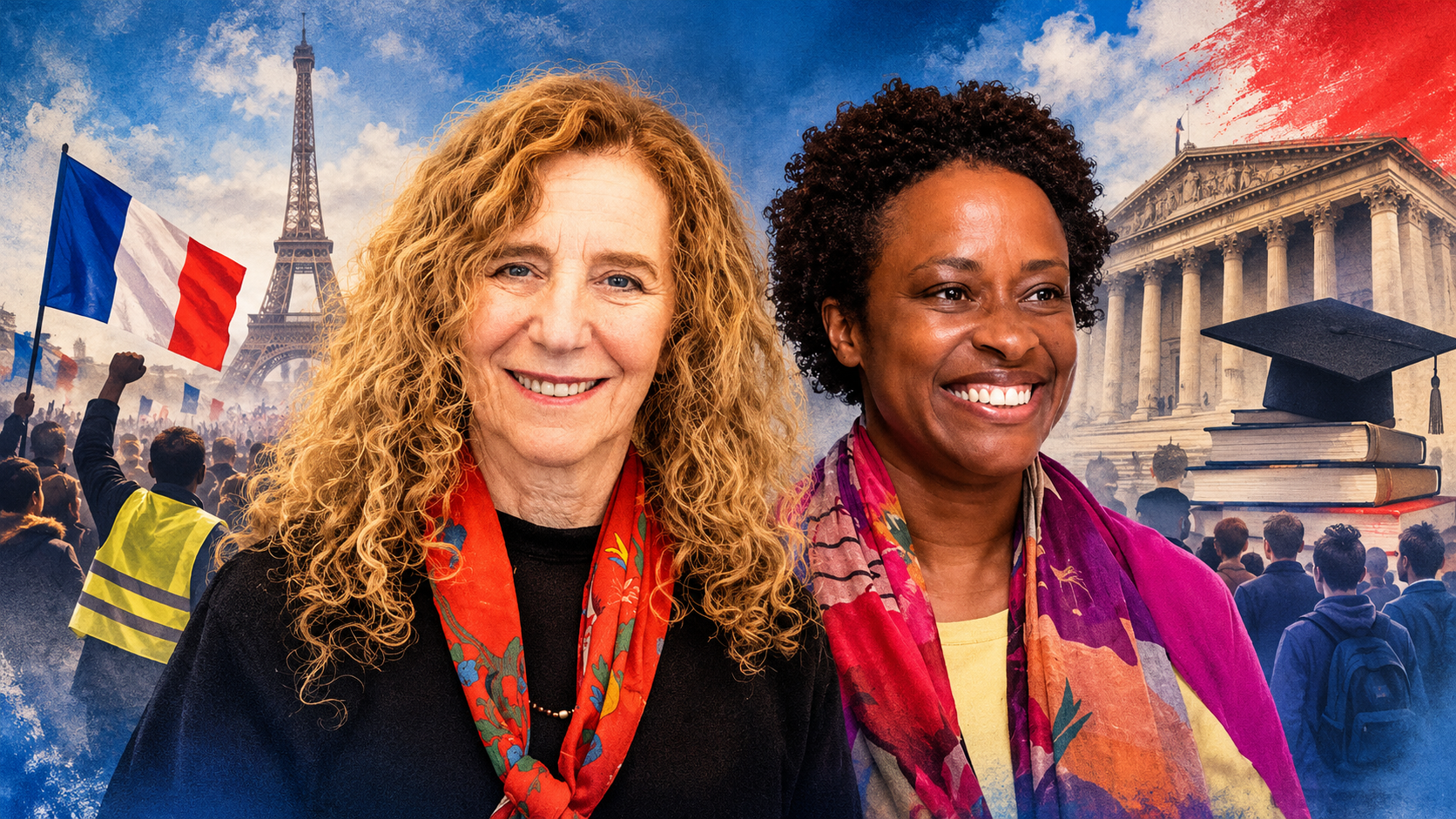
Jean Beaman is professor of sociology, international migration studies, and Black, Racial and Ethnic Studies at the Graduate Center. She’s conducted ethnographic research in France for 15 years and is the author of Citizen Outsider: Children of North African Immigrants in France, published in 2017 by University of California Press. Professor Beaman is currently finishing her next book, Suspect Citizenship: Racism and State Violence in France and the World, to be published by Stanford University Press.
In addition to Professor Beaman, we have with us today, Ida Susser, a distinguished professor of anthropology at the Graduate Center and at Hunter College of CUNY. Her recent book, The Yellow Vests and the Battle for Democracy: Taking It to the Streets of Paris in the 21st Century, focuses on new movements and new visions for democracy in France.
Her previous books include Norman Street, published by Oxford University Press in 2012, which is a study of working-class opposition to cutbacks during the New York City fiscal crisis of the mid-’70s and the transition of Greenpoint-Williamsburg to a gentrified enclave; and her other book, AIDS, Sex, and Culture: Global Politics and Survival in Southern Africa, a history of the power of social movements to transform health.
So, thanks for joining us today, Jean Beaman. Give a shout-out, Jean Beaman.
Jean Beaman:
Hi!
John Torpey:
Hi! And Ida Susser.
Ida Susser – 03:05
Hi.
John Torpey – 03:06
Okay, I think you can tell the difference between those voices, or we’ll try to make that clear as we proceed.
So, let me just get started with the questions I have for you, and let’s start with France, which is what you’re both mostly focused on, if not exclusively by any means. But you’ve both written extensively about France and its politics.
So, let me start with Ida Susser. You’ve written a book about the Yellow Vests movement that started several years ago. Can you give us some background on what’s happening in the streets of France today and how it connects to the Yellow Vests? And then, Jean Beaman, I’ll ask you to follow up with background on the more recent developments. Okay?
Ida Susser – 03:52
Okay. Well.
The student movement started in the suburbs of Paris, particularly in what they call the urban periphery: Créteil, and then where I lived was Saint-Denis, sometimes called the 93, where it’s a very mixed neighborhood, probably one of the poorest neighborhoods in France, but also 30% what the French classify as migrant neighborhoods.
That doesn’t mean they’re all new immigrants. The French don’t talk about exactly the categories that Americans talk about, but there are many immigrants historically from Algeria and Morocco. That’s about a third, but there are also old French residents as well.
But it’s a poor neighborhood, and I’ve been living there off and on for the past decade.
So, what I started studying in France was in 2016, with an Occupy movement called Nuit debout, which was really students. They were the first of this movement cascade. I call it a cascade of movements that started in 2016.
There was a union movement because the Socialists decided to change the labor laws. These labor laws had seniority, a number of hours per week, and very strong protections for workers. The person behind changing those labor laws was Emmanuel Macron, who had been made finance minister in the Socialist government.
The students and the unions came out against this very, very strongly, and the Socialist president, Alain, brought in the change in the labor laws without going through the normal process, like we would with Congress or an assembly. He couldn’t get a vote there. He just made it a kind of legal change without a vote. This is not regarded as democratic in France. It’s called 49.3.
So that’s what happened with the labor laws. The Socialists were seen as traitors, and their election results in 2017 went down to about 7%.
But Macron, who had been the finance minister and initiated these laws, created his own party, where he wasn’t associated with that. The Conservative Republican Party also had problems with corruption. So Macron had an avenue between the Socialists and the Conservatives, and he won the election in 2017.
But from 2016, when he had been instrumental in changing the labor laws, people expected to have problems with Macron. Many, many people said to me they were really going to have problems with him.
And immediately, he changed the student admissions policies, called Parcoursup, which is one of the huge issues that the students came out over this September.
Parcoursup is about student admissions, and particularly in the neighborhoods, it’s an algorithm. So people who live outside Paris are not first in line for the universities in Paris. Those central ones, sort of like Columbia or NYU or, you know, Harvard, are in the center of Paris.
So if you live in Saint-Denis or Créteil, you’re not going to have the same options as people who live in the center. People who thought they had equal options if they did well were told their first choices would be in these neighborhoods, these outside neighborhoods.
So that’s something that was initiated by Macron in 2017, and it’s something that the students at the Sorbonne sat in on in 2018.
Then, of course, in 2018, after that, we had a union strike, a railroad strike, and following that, the Yellow Vests, whom I studied in 2018, came into the streets because Macron put a tax on diesel.
And all of these different movements followed, including the pension movement, where Macron tried to take away the pensions or take pensions out of union control.
So the whole time that he’s been in power, he’s tried to make these changes. He has made these changes, and so basically, since he managed to push the pension reform through without any parliamentary or assembly vote again, just the way they did the labor laws, people in France are pretty outraged.
And he’s had to have six different prime ministers since he put the pension reform through because he can’t get—
John Torpey – 08:53
It’s been a bumpy road. It’s been a bumpy road for Macron.
So, let me turn it over to Jean now and get some of the more, I suppose, contemporary comments, and we’ll come back to the pensions issue, which is clearly a major one in France and has been for a long time.
Jean Beaman.
Jean Beaman – 09:12
Yeah, yeah. Thank you so much.
So, just to piggyback on the context that Ida already provided us, I think the student protests—we have to remember quite a few things. One is, outside of just the Parcoursup contestation, there also are very legitimate issues around the conditions of education in many of these banlieue neighborhoods, thinking about dilapidated buildings, teacher shortages, overcrowded classrooms, etcetera, etcetera.
So, you know, it’s not surprising that this protest erupted at the moment that it did.
I think what I broadly study, or what I’m broadly writing about this moment, is this question of state violence in France and, more generally, the question of a denial of substantive citizenship.
So I think what you’re seeing, both in terms of the student protests and the long history of the Yellow Vest protests and other sorts of movements, is the way that people are rebelling against a state that is continually reminding them they don’t fully belong. And that’s a very, you know, that’s a very French thing.
But I think it therefore is not at all surprising, given everything we’re seeing and happening in France in this moment.
I think the demand for better educational opportunities is really a demand for the full benefits of a republican kind of citizenship or republican kind of belonging. And so I think that’s what, at its core, you’re really seeing.
The other thing I want to bring to the discussion is the relevance, or the ongoing relevance, of France’s colonial history.
When we think about where these dilapidated schools are, they are, as Ida gestured to, mostly in these banlieue communities surrounding Paris and surrounding the other cities that historically have been places where migrants from former French colonies have settled.
And so, you know, we’re seeing, I think, also a very intentional geographical, spatial, colonial mapping of who has advantage in France and who does not. So that’s part of why I think the protests are also making very visible for those of us.
John Torpey – 11:05
Well, I think part of what’s weird for Americans about France is that the money is in town. I mean, obviously, there’s a lot of money in New York City, but most American cities have been emptied out at the center, and the money has moved to the suburbs. And it’s kind of the reverse in France, and in France in particular.
Jean Beaman – 11:32
Yeah, yeah. Exactly.
John Torpey – 11:33
So, tell me a little bit more about the social composition. I mean, we’ve already talked a lot about students, but the Yellow Vests are not students. I mean, who are those people, and what are they concerned about?
Ida sort of hinted at this, but I don’t know who wants to take the question.
Ida Susser – 11:53
Okay, well, the Yellow Vests came from outside Paris. They were initially seen as kind of in contrast to what Jean is talking about. They were seen as old France, as opposed to the immigrants. The word that they often use is new France.
And they were seen and portrayed in the news as possibly right-wing, possibly left-wing, which is why I studied them, because many people on the left were very worried that this was a right-wing movement and that it could have been anti-Islam, anti-Semitic, and racist. That was the question.
And over time, as we see, first, they were also seen as anti-ecological. But over the last seven years, since they came out in 2018, they’ve been converging or joining in tangential ways with environmentalists.
They changed their slogan to “From the end of the month to the end of the world,” instead of just the end of the month and affordability.
And so, although many people did come from the urban peripheries of the cities in the south of France and north of France, not from Paris, they were civil service workers, pensioners, secretaries, truckers, nurses, and teachers. They were not people who normally had ever demonstrated, and nobody was sure which way they would go.
But as it has turned out over the years, they’ve joined the ecological movement. They were very, very strong in the pension demonstrations.
Then, because they were not recognized by Macron as legitimate protesters, they were very subject to police violence. And there’s a group now called Les Mutilés, the Mutilated, because over 100, 120, and more of these Yellow Vests have been hit with these LBDs. They’re like rubber bullets. They lost their eyes. They’ve lost their hands, a hand, their ankles, their feet. So people have lost parts of their bodies in these violent encounters, with the police shooting these LBDs at them, not just tear gas.
And they were never recognized by the government as legitimate protesters, unlike, say, the youth of the university protests.
So they were suddenly aware—which they had not been aware of in the country areas outside Paris—that the police in Paris were very brutal and would really come at them.
And so now, since 2020, they’ve been joining the Black Lives Matter movement against police violence.
So what has happened is that many of these groups have come to recognize what’s happening in the urban periphery, where the large immigrant populations are, although they are much more mixed than in the U.S. And also, the people from the schools in the center of Paris, which are the wealthiest schools, those kids have come out. High school kids have joined the demonstrations in the outer suburbs, in Saint-Denis and other places.
So there’s been a real shift. I think there have been a lot of protests among the students in the banlieues, but usually they’re often not supported from elsewhere.
But this new movement has been supported by high school students throughout France, people in the central wealthy schools, as well as being led by the students in the suburbs, their parents, and the left movement.
And the parents and the representatives of La France insoumise, Mélenchon’s left-wing group, wear white armbands to show that they’re against violence and they’re helping organize.
The assembly members also wear their sashes, which are red, white, and blue, to show that they’re really political officials and that they are not involved in the violence.
So I think it’s a very important kind of collaboration that I don’t think we’ve seen before. And I think was absolutely right. This has not happened before.
John Torpey – 16:37
Okay, do you want to expand on that a little bit, Jean?
I’m curious about this because it seems to me, indeed, that this is a novel development. And it reminds me—this goes back a long way—to the Solidarity trade union movement in Poland, 1979–1980, where the question was: Would the workers and the intellectuals manage to connect with each other and work together? And it sort of sounds like that may be what’s happening in France.
But Jean Beaman, you know more than I do about it.
Jean Beaman – 17:10
Yeah, no, that’s an interesting comparison.
I mean, yeah, I think you are seeing a bit of that. Before September, before this current wave of protests, there has been a longstanding anti-racist movement in France. There has been a longstanding movement against state violence.
And I think, to piggyback on some of what Ida shared, it’s important to keep in mind the changing context of police repression at some of these protests.
So what’s come up a lot in my own fieldwork is people saying that it’s much more dangerous to be on the streets protesting today than it was, say, 10 or 20 years ago.
And so there’s very much a real sense that the novelty of it is more about how police respond to people who are in the street. As Ida mentioned, there are a lot of examples of people who are brutalized, killed, attacked with flash balls and other really high-violence technologies by the police. And that just wasn’t as much the case in earlier waves of protests. I think we have to keep that in mind.
The other thing I would say, though, is that I think the question around immigrants versus non-immigrants is a little bit different from what you might see in a similar context in the United States.
You’re seeing much more of an interracial kind of mobilization on the street, right? So you see people who are from some of these minority communities, immigrants, and also, more importantly, I think, descendants of immigrants who are French themselves.
But you’re also seeing a lot of people who are part of the so-called white left in France. So you’re seeing a much broader coalition, which I think speaks to some of what you were saying, John, around the connections between people who are intellectuals, quote-unquote, and traditional workers. I think you see that element as well.
John Torpey – 18:47
Right. I mean, yes. The image that Ida paints is one of cross-class coalition and cooperation.
Jean Beaman – 18:57
Right, right.
John Torpey – 18:58
Which signals trouble, it seems to me, for the authorities and for the powers that be.
And I can’t tell. I’m not paying close enough attention to be able to say this, but it seems like they haven’t lost steam yet.
Jean Beaman – 19:17
Yeah, yeah. I think it’s been really remarkable how long it’s lasted and how different coalitions, different groups, have latched onto it.
Some of the collectives that I’ve been working with for my work around police violence have also joined this mobilization as a way to rebel against the state and really hold the state accountable for the ways that it’s failed to serve all its members.
So it’s not surprising to me that this broad coalition has been able to absorb so many different kinds of groups.
Ida Susser – 19:47
And I think the fact that, for me, one of the things people said was that the Yellow Vests were right-wing and racist.
I think it’s extremely significant that these people from the rural towns, where I’m sure they grew up with some kind of racism, and I’m sure they had never met a lot of the poor people of the suburbs before, have actually come out and been so active in these new movements.
I think that’s what Mélenchon is talking about. That’s what the left has been talking about, and they’re working in that direction.
But the fact that the Yellow Vests joined them is quite significant, considering the way the Yellow Vests were viewed back in 2018.
And the other thing is that I was in Saint-Denis when Bally Bagayoko, who’s of Malian origin and is Muslim, and who is from Saint-Denis, was elected mayor of Saint-Denis in the 2026 municipal elections this year. He was elected with more than the majority he needed, so there wasn’t a second runoff.
You know, they usually have runoffs with all the different parties, and he was elected in the first round, which means that he must have been supported by a lot of the so-called old French people who live in those suburbs.
So I think it’s quite significant that Mélenchon’s party won that suburb of Saint-Denis, and Bally Bagayoko has been very much defending the students, walking around with his sash, showing he’s an official, and also with a white armband and speaking to the news.
He’s a very significant figure in tying these different groups together.
I was at the celebrations when he was elected, and it was so mixed. It was amazing. People couldn’t actually believe it. This was, I think, June this year. April, I forget. I think it was June this year.
So I think the fact that he’s out there now is very significant for what these movements represent.
John Torpey – 22:12
So, insofar as a lot of this has been built by students, educational spending has been a central part of the discussion.
But tell me a little bit more about the goals that these groups have and what would satisfy them to sort of lay down their truncheons or lay down their arms. I don’t mean to put arms in their hands, but, you know, what would satisfy them as far as the demands that they have?
Jean Beaman – 22:48
Well, I think in terms of the students, there have already been a couple of concessions around the Parcoursup program. For example, they’re going to dismantle it and build it anew in 2028 or something like that.
But I think that’s actually another interesting point about this movement. There are tangible asks in terms of improving the actual physical conditions of schools: changing the size of classrooms, having more teachers, having more classes.
So there are actual tangible asks that can be addressed and that would at least mitigate some of what we’re seeing now.
I don’t think that would prevent the continuation of these protests because, outside of the specific education-related issues, there are some underlying broader social concerns, which I think relate to the lead-up to the upcoming elections.
But there are tangible things around improving schools in a lot of these communities that could be addressed very easily, quite frankly.
Ida Susser – 23:54
I think Macron has, in fact, tried to address them in the last week or so, but people have not really accepted his announcement.
And one reason is because, in 2024, the prime minister, when they had a lot of unrest in these areas, said, “Yes, we’re going to put millions into education,” but nothing has been done, even though it was promised.
So the students are not accepting this fix.
The same happened with the Yellow Vests. Immediately after the Yellow Vests rushed into Paris in 2018, Macron finally said, “I’m going to take away the diesel tax.” But by then, people were so angry about questions like affordability.
They are angry at what the students and everybody call stealing the state, privatization of health services, privatization of education, and not putting money into education, which might increase middle-class kids’ access to private education.
So it’s an abandonment that they see of public education.
And it’s the same with healthcare. People have tremendous respect for the government healthcare system, the government education system, and the government transportation system.
With the withdrawal of funds, they see the students saying, “The government is stealing our futures. They’re stealing the taxes that we put into that.” And the same with the pensions. “They’re stealing our taxes. By taking that money away from our services, they’re stealing our futures.”
And that’s really why it’s such a broad movement.
John Torpey – 25:38
Right. I mean, I have seen intimations about the “No Future” motto returning to the playing field, so to speak. I mean, the slogan that I associate with the birth of punk rock in 1977, the Sex Pistols, and all that.
But it seems as though you’re hearing that kind of talk again, and it revolves around AI, it seems to me, fundamentally.
There are also issues about the budget in France and the budget deficit and that sort of thing. France is in a difficult position to spend its way out of these problems because it’s got a big hole in the budget already.
But I mean, do you see this kind of sense that people are protesting because they don’t see a future?
Obviously, this is for young people primarily. and Jean Beaman is.
Nodding her head, so we’ll give the floor to you.
Jean Beaman – 26:41
Yeah, absolutely. I think that’s a big issue.
I think the youth in France, high school students in France, people about to finish high school, are wondering what the next 20 or 30 years look like, and it’s really unclear.
Part of it is around the economic issues that you outline, John, but also just where is their place within French society?
I just think there’s not a vision that’s been articulated for them that they can really attach themselves to.
So I think that’s a more fundamental question: this crisis of the future of France, with young people being at the precipice of it. I think that’s exactly right.
Ida Susser – 27:24
I think that in France, people have always had lower salaries and wages than, say, we have in the U.S., but they’ve had more security.
They felt that there was going to be education and that there was going to be healthcare.
And I think the idea that they’re stealing the state has been around ever since the first breaking of the labor laws in 2017.
It’s the idea that all the things that young people counted on, including the old form of job security and the pensions, are being taken away.
They all believed that they had those things. They didn’t complain so much about the low incomes because if you have those things covered—which we don’t in the U.S.—if those things are covered by the government, then you’re not so desperate about having an insufficient salary.
So I think the coalitions that we’re seeing between the banlieues, the suburbs, and the rest of France are around a general recognition of the destruction of expectations for everyone’s future.
I don’t think it was really focused originally on AI. I think it was before AI. It’s the destruction of the social contract that was accepted and built on since World War II.
The French have fought for that more than any other state in Europe, and more than the U.S. And this is why they have been marching about pensions since the 1990s. But, you know, 1995, I think. Nobody touched it then. The government didn’t touch it again until Macron came in with an ax.
I know that Macron is recognized internationally as important in the EU, but in France, he’s seen as destroying people’s options.
John Torpey – 29:39
I think his, shall we say, self-confidence also has an off-putting quality in the French context.
But I don’t want to put AI in a position that it doesn’t deserve, so to speak. I’m also interested in trying to figure out why we’re seeing this wave of protests, not just in France but in India, for example, that again is really around educational spending, basically.
There’s this sense that people are very concerned about young people, especially.
I’m not so concerned about it because I’m old and I won’t be around that much longer. But if you’re 20 or 25 and it looks like AI is taking your job, that could understandably upset you.
And I wonder how much you see that as a connecting link to other protest movements elsewhere in Europe and beyond.
Ida Susser – 30:42
As I said, for me, I have not heard it from the French students, but it may be that a more international view might bring it up.
But look at the Serbian protests. I think the youth are out there. I’m not sure that, unless it’s kind of in the zeitgeist, they’re talking about AI, as far as I’ve heard.
Jean Beaman – 31:04
Yeah, I haven’t heard as much specifically about AI, but I do think there is a broader conversation to be had around how youth in general, not just in France, are thinking about the changing nature of work and what that portends for their future.
So I could see it folding into that conversation, outside of the French context specifically.
John Torpey – 31:20
Well, and I think Ida’s comments about the fracturing of the welfare state also exacerbate this kind of sense that my education, however fancy, isn’t really going to get me a job, or it’s not going to get me the kind of job I thought I’d get.
And therefore, I’m going to need other sources of sustenance, and that’s what we call the welfare state.
As you say, I think France, maybe along with Germany and Italy, has been especially attached to its welfare state, and it’s in real trouble now. And they see that as really affecting their present and their future.
Ida Susser – 32:03
When I’ve heard the students who are from the upscale, wealthier neighborhoods talking now, they are saying the things that Jean said.
They’re saying there’s inequality. Yes, we have a problem with our school buildings too, and absent teachers, but it’s nothing like the suburbs.
And they’re going up to the suburbs in solidarity, not seeing themselves as being under the same, as you said, sort of colonial, internal colonial conditions.
They don’t envision themselves that way. In fact, they’re up there. They’ll get into the inner, into the fancy Parisian schools, but they’re still, in general, aware both of the inequalities and of the undermining of the entire structure of the social contract in France.
And it’s happening later in France than elsewhere.
John Torpey – 33:00
Jean?
Jean Beaman – 33:03
Yeah, I agree with that.
In terms of the rupturing of the social contract, I think France has frankly been in crisis for quite some time.
And so, at some point, we’re just continually reaching the boiling point where something has to happen, whether it’s a very clear right-wing shift, which I personally think will happen, or something else of that magnitude to really put things into relief.
John Torpey – 33:29
Well, I think this has been very enlightening. I’m afraid we’re running out of time, but I want to thank Jean Beaman, Professor Jean Beaman, and Professor Ida Susser, both of the CUNY Graduate Center, my place of employment, for taking the time to talk to us today about the recent protests in France and beyond.
I want to thank Sebastian Conseco Ibarra for his technical assistance, and I want to thank Ida’s fellow South African, Duncan McKay, for letting us use his song “International Horizons” as the theme music for the show.
This is John Torpey saying thanks for joining us, and we look forward to having you with us for the next episode of International Horizons.
Jean Beaman – 34:15
Thank you.
Ida Susser – 34:16
Thank you.