Official Reports
NASA UNIDENTIFIED ANOMALOUS PHENOMENA Independent Study Team Report
Source: Nasa
Figuring out the truth behind Unidentified Anomalous Phenomena (UAPs) takes more than speculation, it requires hard science. NASA is stepping up to lend its heavy-hitting tech to the government’s UAP investigations. By combining Earth-observing satellites, high-res commercial imagery, and advanced AI, NASA aims to replace grainy footage with rigorous, well-calibrated data. Beyond the tech, they want to erase the stigma around reporting sightings by tapping into commercial pilot safety systems and exploring smartphone crowdsourcing apps for the public. It’s time to turn a once-taboo topic into a serious, transparent scientific investigation.

Preliminary Assessment: Unidentified Aerial Phenomena
This preliminary report is provided by the Office of the Director of National Intelligence (ODNI) in response to the provision in Senate Report 116-233, accompanying the Intelligence Authorization Act (IAA) for Fiscal Year 2021, that the DNI, in consultation with the Secretary of Defense (SECDEF), is to submit an intelligence assessment of the threat posed by unidentified aerial phenomena (UAP) and the progress the Department of Defense Unidentified Aerial Phenomena Task Force (UAPTF) has made in understanding this threat
The United States and the Soviet Union Sign a Space Cooperation Agreement
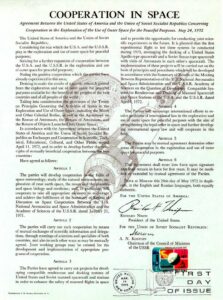
50 Years Ago: The United States and the Soviet Union Sign a Space Cooperation Agreement
During the 1960s, collaboration in the space arena between the United States and the Soviet Union remained at a low level, the relationship characterized more by competition than cooperation. In the climate of détente in the early 1970s, the two nations began discussions to develop a common docking system. On May 24, 1972, during their summit meeting in Moscow, the leaders of the United States and the Soviet Union, President Richard M. Nixon and Premier Aleksei N. Kosygin, signed an agreement on cooperation in space. One of its articles called for the development of a joint system to allow their spacecraft to dock with each other in orbit, laying the groundwork for the Apollo-Soyuz Test Project, the first international human spaceflight carried out in July 1975.