When Foreign Aid Fuels Authoritarianism: Migration Management in Africa
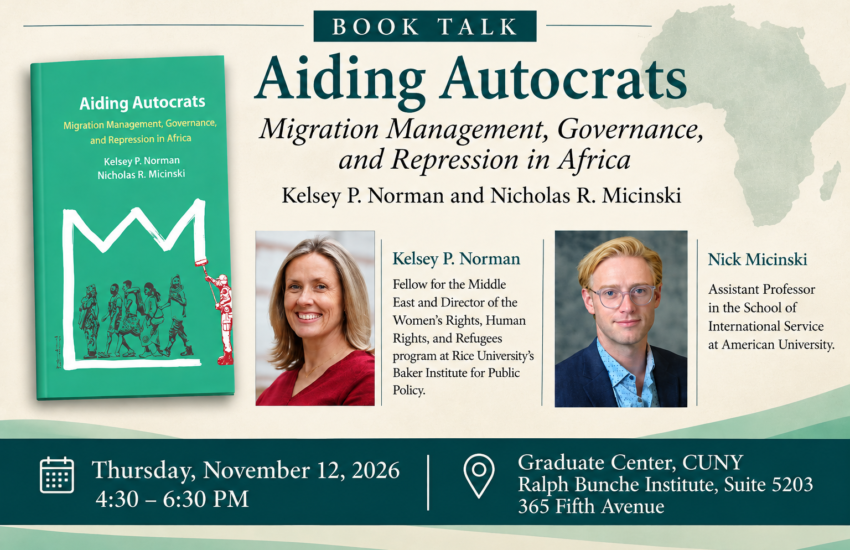
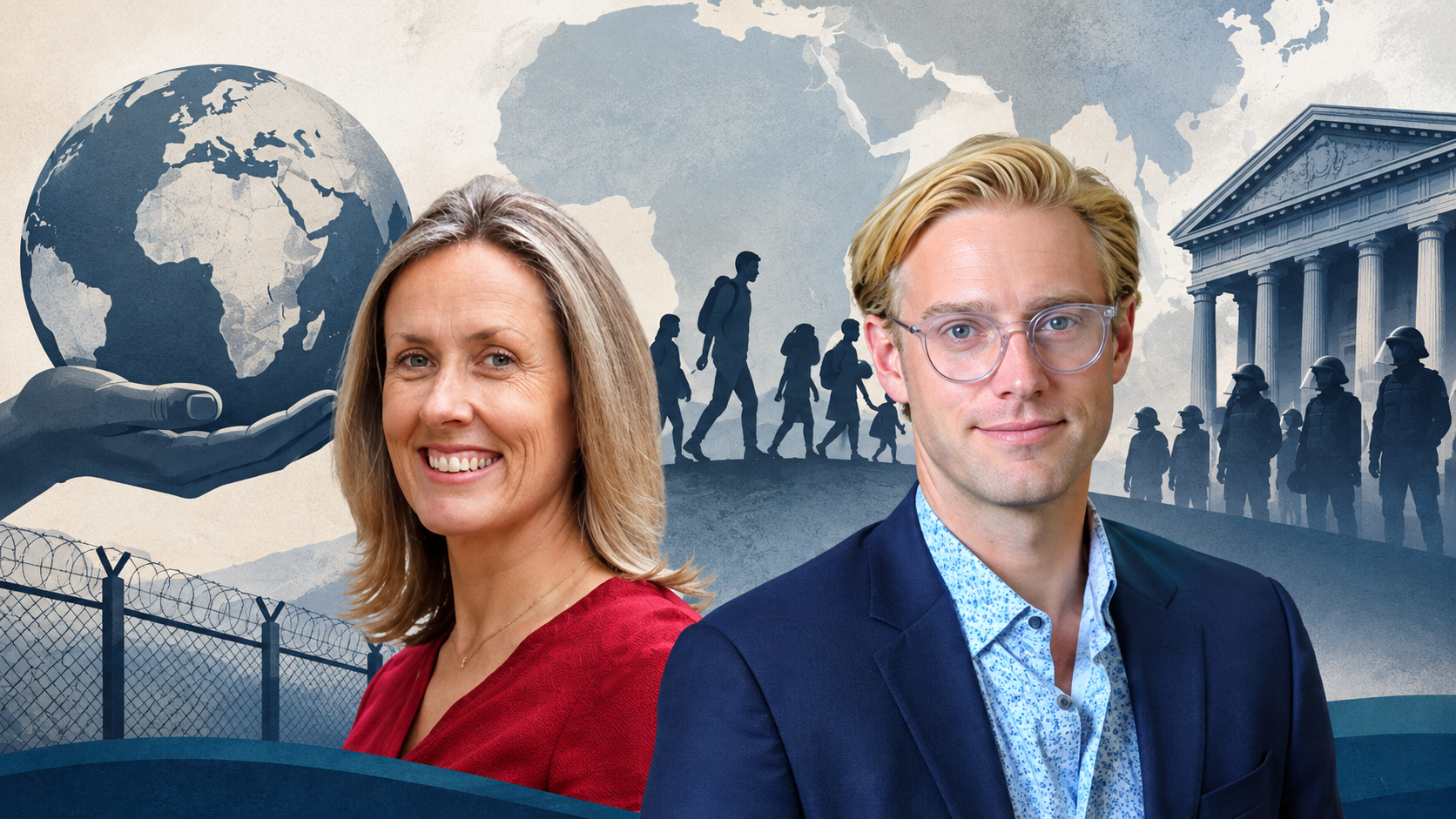
Can foreign aid designed to address the root causes of migration end up strengthening authoritarian governments and undermining human rights? In this episode of International Horizons, John Torpey speaks with Nick Micinski and Kelsey Norman, authors of Aiding Autocrats: Migration Management, Governance, and Repression in Africa (Cambridge University Press). Drawing on research in Kenya, Ethiopia, Sudan, and Egypt, they examine how European migration management aid has reinforced state security apparatuses, enabled repression, and perpetuated patterns of external control over African countries. They also explore the consequences of these policies for European and American democracies and discuss how more effective, humane, and regular migration systems might offer an alternative to increasingly restrictive approaches.
Transcript
John Torpey — 00:04
Millions of people around the world face the choice between staying where they are and leaving to try to make a better life for themselves and their families. But immigration policies don’t necessarily invite such migration. Foreign aid is supposed to help countries in need to develop themselves economically and politically, which may help some people decide to stay put, as many of them would surely prefer to do. But it turns out that there may be unintended consequences of sending foreign aid to countries that need such aid. Specifically, aid that is meant to promote development may end up in the hands of needy people, but not in the hands of needy people, but in those of autocrats. So, what’s going on here? To address these issues, we’re fortunate to have with us today Nick Micinski and Kelsey Norman, the authors of a new book called Aiding Autocrats: Migration Management, Governance, and Repression in Africa, recently published by Cambridge University Press. Nick Micinski is assistant professor in the School of International Service at American University and author of two previous books on international migration management. Most recently, the book Delegating Responsibility: International Cooperation on Migration in the European Union. Nick’s co-author Kelsey Norman is fellow for the Middle East and director of the Women’s Rights, Human Rights, and Refugees program at Rice University’s Baker Institute for Public Policy. She’s the author of Reluctant Reception: Refugees, Migration, and Governance in the Middle East and North Africa. Thanks for being with us today, Nick Micinski and Kelsey Norman.
Kelsey Norman (02:01)
Thanks for having us.
Nick Micinski 02:02
Thank you.
John Torpey (02:02)
Great, great that you could do this. So, I’m looking forward to this discussion. We’ll start kind of with a broad overview. I’d like you to give us sort of broad overview of the picture facing refugees at present. I remember a few years ago, not very long ago, a meme was circulating about the number of refugees around the planet, something like 100 million or so, and I couldn’t tell whether it was a positive or a negative kind of finding because it was a growing absolute number, but a declining percentage of the world’s populations. So, how big is the refugee problem today, as compared to the past.
Nick Micinski (02:44)
Thank you for that question, John. Well, numbers of refugees are complicated and contested. They obviously ebb and flow because of different conflicts or different reasons for displacement, but they remain relatively small overall in terms of like global population and the number of migrants as well, but right now there are actually only about 40 million individuals who are refugees as of like mid 2026. That number of 100 million includes internally displaced people as well, and this number actually has gone down in the last year. So, we see a little bit less displacement than 2025 in terms of the like overall displacement compared to the past, the largest displacement in the last 100 years was from World War II, with about 60 million people, followed by the partition of India and Pakistan, with 20 million people. What’s a little different about the sort of displacements today is that it’s sort of the sum of many smaller conflicts and displacements, so that add up to a huge number of people displaced. So, we see in Venezuela, Ukraine, Syria, Afghanistan, and Sudan millions of people who are displaced, which adds up to the sort of 40 million that are there. And remember, about 65% of all refugees are hosted in the neighboring countries and 70% in low and middle income countries. So, most refugees are never coming to the U.S. or Europe. They’re being hosted and helped in the global south.
Kelsey Norman (04:14)
Yeah, and just maybe a few other points on those statistics. As Nick said, they can be very contentious, and different actors have different incentives around sort of representing the numbers in a certain way, or even inflating those numbers to some extent. So, you might see UNHCR talking about like unprecedented global displacement, and when that number of globally displaced surpassed 100 million, as you said, that was kind of a big, you know. There was a lot of fanfare around that, but as Nick said, that number includes international or sorry, internally displaced people (IDPs). So, it’s a little bit of a misrepresentation to say, you know, it’s not 100 million or even 120 million refugees. It’s about 40 million, as Nick said, and as I share of the overall migrant population, the number of refugees has stayed relatively stable, and the number of migrants globally has stayed relatively stable. So, you know, as far back as we can really measure, the number of migrants as a share of the world’s population has been between 3 and 4%, and that actually hasn’t changed. So, there’s actually really more like remarkable stability rather than unprecedented global migration in our current era. And in terms of you know host states who are actually the ones generally reporting these numbers of refugees globally, there are sometimes incentives to represent the number of people they’re hosting, you know, as a as a greater share than they actually represent, and that’s an example we talk about in the book. is from Egypt, where the number of refugees, or sorry, they actually call them the number of people in a refugee-like situation. So, there’s a little bit of wordplay there, but that number grew from about around 1 million to 5 million within a year, and then it grew to 9 million more recently, and it doesn’t actually represent you know that large of an increase in refugees hosted. It was more sort of the Egyptian government using those large numbers and proclaiming those numbers as a way to ask for further funding to continue hosting refugees, and almost as sort of a veiled threat to Europe, saying, “Look at all these people in precarious situations living on our territory. Wouldn’t it be a shame if they suddenly found their way towards Europe?” So again, these numbers can be quite contentious, and different actors have different incentives around representing them in different ways.
John Torpey (06:37)
Thank you. I mean, I think that’s very helpful to allow people to understand that you know this is not a cut and dried sort of question. How many refugees there are, and as you said, the 100 million number breaks down between refugees who have left the country of origin and people who have stayed in the country of origin, haven’t left the country, but are displaced otherwise. So, it’s a complicated it’s a more complicated thing than people might appreciate, and it’s helpful to have that background. So, and against that background of the global refugee problem, you argue in the book that what you call migration management aid is part of a quote part of a longer pattern of European control of and extraction from Africa. In other words, I would say it’s a form of neo-colonialism. And I guess the question is, you know, how so, and to what extent does this apply? You know, this podcast emanates from the United States, from New York City. Does this apply to USAID, or did it apply to USAID in the past? And if so, you know what’s the argument for USAID or comparable agencies in Canada?
Nick Micinski (08:01)
Sure. So yes, you’re right. This is we characterize this as a type of neo-colonialism, and in the book, we trace the connections between development aid and colonialism. Of course, this isn’t starting with the U.S. It starts actually with Britain and the Colonial Development Acts back in the early 20th century, which argued actually to invest in the colonies not for humanitarian reasons, but to increase international trade and to create a market for British goods. This funding from the UK and other European powers was both funding and training that oriented colonial economies and the structures of the colonies towards the metropole. Of course, the U.S. history and USAID are important here. Very later on, after that, U.S. President Truman, as part of his point four plan, announced the creation of the Technical Cooperation Administration, which was later renamed the U.S. Agency for International Development (USAID). Well, it’s obviously done a lot of good work, and Kelsey and I want to emphasize this. We do believe that USAID has done really important work both for refugees and writ large, but it also was clearly a tool for foreign policy during the Cold War and more recently during War on Terror. One of the logics that developed out of this was that failed states were a risk for the world because of uncontrolled territories. These uncontrolled territories could harbor terrorist groups. So, during the war on terror and earlier, the U.S. and EU funded migration management as a part of state building exercise to securitize and control the movement of people, in part because of this worry about terror crossing borders, and migration management aid is one of those ways to build the capacity of a state to restrict the movement of people. Our project looks larger than that. It sort of traces in the last. 20 years from 2002 to 2022, how much development aid was spent on migration management? And we say for the first time, this number is 73 billion dollars, and it’s increased 1,000% in those 20 years. But this isn’t the start of it. These aren’t the like the current development aid was not the start of migration management, we see it as sort of establishing a pattern of control and extraction over the last 100 years. And I’ll just give you the case of Kenya, for example. During the colonial period, the British set up the Kipande pass system. I’m sure you have heard of this. Is when African natives, in order to move between areas, had to have a little pass around their neck, and which gave their employer and their wages, and literally controlled both their ability to move and how much they could make in different areas. And in addition, the British also set up a system of camps to detain suspected Mau Mau, which they used to both interrogate and torture local populations, both for control and for security purposes. Now, after independence, the new Kenyan independent regime also had a similar system of camps. They were actually in the north. This was during the Shifta Wars, and the newly independent government established these sort of forced villagization and camps, where in because of security reasons they said people couldn’t move between districts unless they had a pass to be able to move between these areas. Zoom forward to the 1990s, we have the Somali refugees entering Kenya, and we have a similar refugee camp system, where there are camps which are closed and require camp director to issue a pass to travel between areas to go to Nairobi. So, the pattern of control is established across these periods. There’s encampment in rural areas, racialized policies, and it’s all implemented through a security apparatus. And during each period, there’s actually European actors and European funding that is part of the entire system. The structure of this aid parallels clearly the aid and control that happens today. Much of it is about setting the agenda, the funding, and leadership that is coming from Europe and Europeans. And in the U.S., they also do it in Latin America too, but we studied mostly Europe and Africa. But it’s not done alone. This is actually in partnership with African elites in the government, and actually this builds on Mamdani’s idea of indirect rule that the interests of elites are act of African elites actually align with colonial powers, and we saw this throughout the project. It wasn’t just Europeans dictating how migration management could go. In fact, African leaders were part and parcel to the negotiations and helping to dictate what kind of processes or what kind of projects were going to be funded. They’re of course in the interest of their careers and the powers that their agencies that they represented, and not really in the interests of refugees or the citizens and potential migrants that would have been there. So, our book tries to emphasize that it’s not just neo-colonialism writ large, but there is real agency from African governments, and they’re pursuing their interest, the interest convergence of Europeans and Africans, African governments together.
Kelsey Norman (13:23)
Okay, maybe I’ll just add Nick’s answer was very thorough, but I’ll just add quickly that, you know, we conceive of this modern form of migration management aid, which has these historical parallels that Nick was just discussing. But in its modern form, we see migration management aid as encompassing these two different strands. So, one strand is more closely aligned with what you would conceive of as traditional development aid. So, trying to improve economic development, governance, you know, the performance of civil society in countries that receive it, and that’s the kind of funding we would expect to see under like USAID or other European development agencies, but the other component of migration management aid is aimed at improving the physical capacity of recipient countries to control their borders. And this, you know, in line with what Nick was talking about in sort of the ’90s and early 2000s, focus on like mitigating “quote unquote” failed states and the ungoverned territory, this aspect of the aid really focuses on building out state capacity, and that has all sorts of implications for security actors within recipient states, in which we see these possible unintended consequences that impact not just migrants and refugees, but also citizens of those recipient countries. And so, we account for both components of migration management aid because they’re built into these funding packages. So in the book, we’re most significantly investigating this one particular pot of money, the European Trust Fund for Africa, that came about in 2015 in the wake of Europe’s so-called refugee crisis, and this was a pot of money distributed all across North and Sub-Saharan Africa to do those two things: to develop countries with the hope of mitigating these root causes of migration, but also with the aim of physically capacitating states so that they could prevent uncontrolled migration. And so, USAID, as Nick said, has been complicit in doing this in our own Western Hemisphere and also across North and Sub-Saharan Africa. But Europe is really sort of the main actor; has become the main actor in this field, especially in that region since 2016. And so, we’re not saying that humanitarian aid writ large or development aid writ large should be ended as it kind of has been since 2025 or minimized to such an extent. But we are arguing against the one component of migration management aid that really aims to physically capacitate states to control migration because of these negative consequences that we highlight in the book, and that’s what we hope to sort of shed light on through this research,
John Torpey (16:04)
Right. So that’s very useful and helpful. I guess the next question I want to ask is, you know, you’re good political scientists, so you come to your conclusions in part on the basis of comparative analysis, and I’m sort of blanking on the names of countries, but maybe you could talk a little bit about the variation across these different countries because that’s obviously an important part of any social science research.
Nick Micinski (16:32)
So, our book looks at four different. I mean, besides doing a quantitative study, we also look at four in-depth country case studies: Kenya, Ethiopia, Sudan, and Egypt, and sort of traced the long array of migration management in each of these countries, leading to the sort of more recent period. And our hope was that by comparing across different regime type democracies to authoritarian and different levels of development and different sort of roles in migration, that we can understand better how this how this operates, and in our best case scenario, Kenya is a robust democracy with a middle income country. We still see many risks of development aid for migration leading to authoritarianism and repression. There was more accountability and ability for courts to intervene and civil society to push back, but we saw some funding going to things like the National Counterterrorism Center in Kenya. If we look in Ethiopia, this is an open anocracy, which is when a country has some electoral competition but is really one-party rule. It had a pattern of migration control from Addis, in which they were trying to control the rest of the territory, centralizing control and using resettlement or blocking aid to hurt their rivals. In 2016, there was a big conference held by the UN in which Ethiopia actually promised these big reforms for refugee policies, but many of those policies were failed to be implemented in part because the country devolved into civil war. And during that civil war, the refugee aid that was getting into the country got politicized and used as a weapon during that war. I’ll hand it over to Kelsey now. I’ll talk about the other two countries.
Kelsey Norman (18:20)
Yeah. So, Egypt sort of maybe most similar to Ethiopia, is effectively a closed democracy or a almost fully authoritarian government. You know, post the Egyptian Revolution, there was a bit of competition for who would ultimately come to rule Egypt. But with since 2014, current president Al Sisi has been in power and has really solidified his hold through authoritarian rule. So that around that same time, Egypt began sort of signaling to Europe that it was interested in cooperating further on migration. And in 2017, they came to an agreement under the EU Trust Fund for Africa to receive funding. And in Egypt, we see how, because of the focus on infrastructure improvement in the country, which was is very much in line with the prerogatives of the Sisi regime, we argue that it’s it sort of helped free up the government to spend more of its own funding towards these mega infrastructure projects that are almost entirely built through military contracts, with the Egyptian military being the most repressive institution in the country, and then in Sudan, it’s gone through actually a whole host of different forms of governance since the implementation of funding under the EU Trust Fund. So, in 2019, there was a popular revolution, which led to a transitional government. But ultimately, there was another military coup in 2021, followed by a descent into civil war since 2023. And so, Dan, of our four cases examined in the book, is sort of the worst-case scenario for a country receiving migration management aid. Especially because the government was really never meant to, or the EU was really never meant to set up an agreement with the Omar al-Bashir regime pre 2019 because of its ICC indictments. So, you know, it was already a questionable form of interaction on this topic with the government of Sudan, but then so much of the funding of the regional funding in Sudan went towards capacitating border security, and the Rapid Support Forces had already been appointed as the border security force within the country, patrolling its northern borders with Libya and Egypt. So, there were all sorts of questionable practices in place in terms of, you know, further capacitating pre-existing authoritarian state apparatuses within the country.
John Torpey (20:49)
Thank you. So, another point you make in the book is that it’s not just the recipient countries that are affected by this aid, but the European countries that give the aid in the first place, and I mean, I don’t know about Europe so much, but about you know the United States. Famously, people think that the amount of foreign aid we spend is vastly higher. I don’t know what your typical answer is. Like 10% of the federal budget or something goes to foreign aid when it’s in fact well under 1%, but there are effects, in other words, on you know the donor countries as well. So maybe you could talk about the consequences for the donor countries other than you know how much people think is being spent on this.
Nick Micinski (21:39)
Sure. So, we see negative impacts on both European and American democracy in several ways. One is just the drive to try to prevent people to be able to have the fundamental right to seek asylum. Right within the European Convention, they have the fundamental right to seek asylum, and these initiatives are actually trying to undermine that universal fundamental right that people have the right to get to Europe and claim asylum. Right? I mean, there are lots of other systems that are involved there, but the whole push is trying to prevent people who are seeking protection from getting that protection. In the process of doing that, it actually was willing to make partnerships with authoritarian regimes, which violate its own rules and violate its own sort of process rules as well. So, in order to make this agreement, the European Trust Fund for Africa, it is actually an emergency agreement. In it, in sort of one of the footnotes, it declares 17 countries in Africa in crisis, and that because of that, they’re able to bypass contracting law, right? Typical contracting law that the EU has to do. Well, there’s no evidence that these countries are in crisis. I don’t think many of these African countries would appear to be in the crisis that they’re suggesting that it is, and so it’s justifying without any evidence or any sort of protocol that they’re going to suspend the rules. And then they were able to push out this money out the door very quickly and with less accountability and monitoring, which is one of the things that we point to as one of the risks for leading to more authoritarianism.
Kelsey Norman (23:09)
Yeah, and in addition to that, we argue that, you know, the way that the EU has continued to shirk its responsibility towards asylum seekers has instead of resolving its sort of own internal politics over this issue has led to the normalization of these like pretty extreme responses to migration. So this idea of you know safe third country agreement, sending people elsewhere to seek asylum instead of as Nick was talking about giving them access to territorial the right to territorial asylum or setting up these return hubs, as it’s most recently proposed doing, allows for the normalization of what is acceptable in terms of the treatment of asylum seekers and refugees and migrants, and the far right parties that are sort of often the origin the places of origin for these more extreme responses to migration have been just given sort of endless support over these issues. And the problem with that is that the far right parties are not just offering up quote unquote solutions to migration that are fairly extreme. They’re offering all sorts of other extreme ideas around you know anti human rights Platforms, anti-LGBTQ platforms, anti-democracy and anti-EU stances more broadly, and so the normalization on these issues of migration has led to the acceptance of these very extreme ideas as basically mainstream, and we see that same sort of pattern at play in the U.S. context as well, that you know, undermining rights to asylum, but also to sort of due process on the issue of migration, has led to a crisis of democracy more broadly, not just on the issue of migration, but of you know basic tenets of our of our rule of law. And so, we argue that this willingness to accept these extreme responses to migration has consequences not just for recipient countries of this type of aid we’re investigating, but also for the countries that are that are offering this type of funding. So yeah, ultimately, we see this as kind of kind of an it’s painted as a win-win situation, but it’s really a lose-lose situation for donor countries and recipient countries alike.
John Torpey (25:28)
Well, that leads me into my final question, which I want to kind of zoom back out to the big picture, and you know, bears on some of these issues that you’ve just been taking talking about. I heard over the weekend an interview on the New Yorker Radio Hour between David Remnick, the editor of the New Yorker, and Timothy Garton Ash, their distinguished historian, especially in Eastern Europe, but he’s got a book out about Europe, I think, more generally. And you know, David and Remnick asked him about the migration issue, and his response was that basically what people want, and I think this there’s polling data to support this for the United States as well, but that you know basically what people want is a kind of regularization and stabilization of migration. That you know, people are not coming in an unauthorized sort of disorganized sort of way, but they’re not in principle opposed to migration per se. I mean, there are all kinds of reasons why Europe and the United States and other places really could use immigration, but this has been extremely, as you were just suggesting, extremely controversial and leading to backlashes against foreigners who are perhaps taking jobs or just changing the culture of the you know the country in question. So, I wonder whether you think Timothy Garton Ash has it right, and whether you know a stabilized kind of immigration system and procedure would help to allay these concerns that people seem to have about immigration today.
Kelsey Norman (27:16)
Yeah, I mean, I think I think he does have it right. I think, as you said, there’s polling to suggest that in many different jurisdictions that are struggling with the politics of this issue, and I think that you know if we take the UK as an example, as we were just talking about, you know that’s offered these rather extreme responses to relatively small levels of uncontrolled migration, and yet it’s led to this immense backlash. But responses like the UK Rwanda deal, or you know, finding ways to turn back boats attempting to cross across the channel, again, relatively small numbers of people, and yet politicians have been able to capitalize on this issue to garner votes, and you know we certainly saw that in the lead up to Brexit in 2016, right? So, we think about Nigel Farage and like that picture behind you know his campaign of the bus or like the bus with the mass numbers of asylum seekers attempting to cross, and these were not people heading towards the UK, right? These were photos of that moment in 2015 when large numbers of Syrians and others were attempting to enter Greece and other sort of Balkan countries from there. And yet, it was utilized by UKIP by other far right parties across Europe to scaremonger around this idea that being part of the EU institution or just not having enough quote unquote control over borders would lead to this mass number of people arriving suddenly in this uncontrolled fashion, and so I think that has driven so much of the policymaking on immigration, both in Europe and the UK, but also here in the US, that we’ve gotten so far away from extolling the benefits that migration can offer, and the economic consequences of this, especially in our country here in the US, with the policies we’ve had in place over the last two years, are already being felt and are going to be continued to be felt in industries, you know, across the board: construction, agriculture, the service industry. People, we don’t have enough people to fill jobs, and people that we do have here are afraid to go to work now because of the mass ICE raids that have been, you know, this drag now we’ve created that’s been forcing people into detention and then even deportation over the last few years. So, we’re going to feel the economic consequences of this. Europe is going to feel the economic consequences of this. And as you said, the policies being put in place by politicians do not match what people want. They actually do, you know, even with the scaremongering, people still want migration, and so I don’t know the exact polling in the UK, but recent polling from the US shows that at least 80% of people want what you said, like a fair immigration policy. They want some form of border control, but they also want to under they want to see and feel the benefits that migration can bring. So, I think it’s about de-securitizing this issue, and you know, making it so that politicians cannot just continue scaremongering on this issue. Because ultimately, like we as citizens are all losing, and immigrants themselves want these opportunities to either come to countries like the U.S. or the U.K. and also to remain safely without fear of being snatched up and deported suddenly. So, we have to make immigration, you know, a normal phenomenon again.
John Torpey (30:49)
Right, Nick. Do you want to add anything to that?
Nick Micinski (30:52)
Yeah, I had 2.1 is that when we think of migration management, sort of the migration management programs around the world, they were working to address the root causes of migration, right? Trying to prevent wars, or to help with economics, or when a disaster happens, or with poor governance. But sort of the forgotten art of migration management is that they need to increase the legal and regular ways to migrate, right? So yes, you can try to eliminate the push factors, but we need to actually think about how to make the structures of it better, which means increasing the number of visas and ways in which people can migrate legally, right? But the U.S. and Europe have gone the opposite way; they’ve cut legal pathways, which has forced migrants and employers to rely on undocumented migration. When we think about uncontrolled migrations, people who are crossing the borders, they’re coming for asylum. If it feels unregulated, that’s because we’ve failed to invest in the capacity at the border to host and process people. Right. If you want to process asylum claims faster, fund more asylum judges, right? We know that this is possible because in this last year, Congress funded ICE with unprecedented amounts of money, enabled to hire lots of new officers and buy detention centers. Imagine if we invested that capacity in the humanitarian side, in providing support for people right when they come across the border and processing their claims very quickly, right? That would be a different type of legal and organized way of crossing the borders. And at the end of the day, that would be a recommitment to our human rights, right? People, if we believe in rule of law and democracy, it fundamentally is about having a legal process for someone who is fleeing for their life, where they can come to a country and ask for protection. And if we just close our border and pretend that’s not an option, we’re actually violating U.S. law, not just 1951 Convention. It’s U.S. law that’s being violated at the same time. So, I’ll leave it there. But thank you very much for this conversation.
John Torpey (32:59)
Absolutely. Well, that was very illuminating. That’s all we have time for today. I want to thank Nick Micinski and Kelsey Norman, authors of the recent book Aiding Autocrats: Migration Management, Governance, and Repression in Africa, and for taking the time to talk to us today about their book. I want to thank Sebastian Canseco Ibarra for his technical assistance, and to thank Duncan McKay for letting us use his song “International Horizons” as the theme music for the show. This is John Torpey saying thanks for joining us, and we look forward to having you with us for the next episode of International Horizons.