
The Emerging Anocracy: AI, Tech Oligarchs, and the Future of Democracy with Alexis Crews
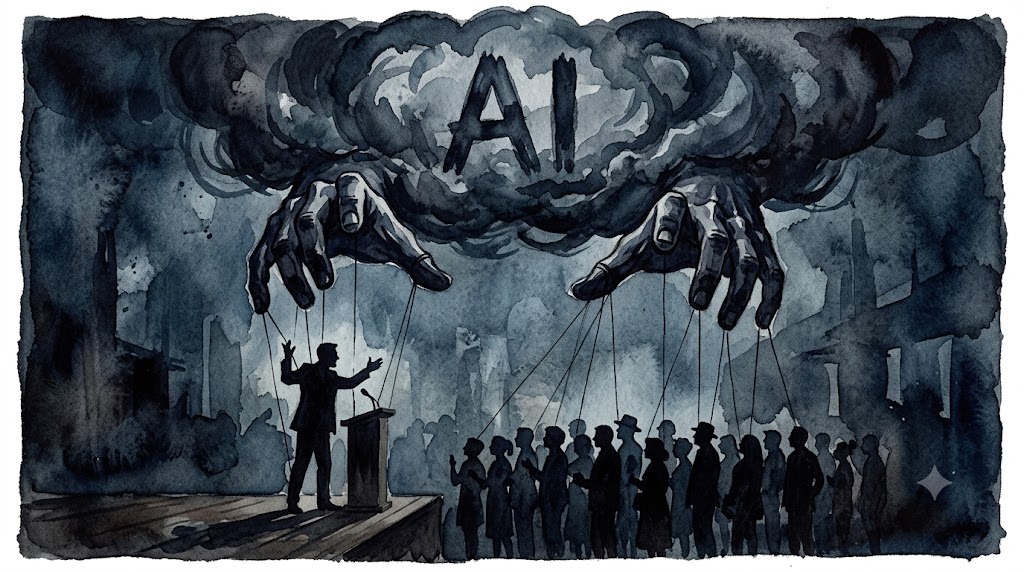
In this episode of International Horizons, RBI Acting Director Eli Karetny sits down with Alexis Crews, founder of Enough Consulting and former strategic advisor for governance at Meta. Crews explores how the proliferation of AI and digital platforms has shifted global politics into an “anocracy”—a precarious gray zone situated between traditional democracy and authoritarianism.
Transcript
Eli Karetny:
Welcome to International Horizons, a podcast of the Ralph Bunche Institute for International Studies, that brings scholarly and diplomatic expertise to bear on our understanding of a wide range of international issues. My name is Eli Karetny. I’m the acting director of the Ralph Bunche Institute at the Graduate Center of the City University of New York this year, with John Torpey on sabbatical. It has been my great honor to host this podcast in the fall. John will be returning to the institute as director and as host of International Horizons.
I’m grateful to John for the opportunity to serve as the institute’s acting director while he was on leave; this gave me the chance to develop some new initiatives at the Institute, like the project on UAP studies and international security, which I will continue to lead as I return to my duties as Deputy Director. This new project will host periodic public events and podcasts with prominent academics and researchers doing work in the emerging field of UAP studies. In the fall, I’m excited to announce we’ll have the renowned international relations scholar Alexander Wendt as our first guest to discuss his new book on the national security implications of UAP.
But today, we’re here to discuss how technology may impact the future of liberal democracy. Once proclaimed to be humanity’s final form of sociopolitical organization, Western liberal democracy may be giving way to a new system of technocratic control ruled by codes, protocols, and algorithms, which determine what we pay attention to, how we form opinions, and even how we experience our social reality. The appearance of democratic consent persists, but it is now manufactured in new ways. The reality is that information shapes our decision-making in a manner that fundamentally challenges the concept of popular sovereignty; data, which informs our decisions, is censored, our choices monitored, and public narratives engineered.
What forces are propelling this emerging post-democratic system, and what can be done to counter the momentum? Here with me today is Alexis Crews. Alexis is the founder of Enough Consulting and a strategist working at the intersection of technology and geopolitics. She previously worked at Meta, where as a strategic advisor for governance, she developed frameworks for emerging technologies and led educational programs for the Facebook Oversight Board, focusing on global compliance and policy engagement. In 2019, Alexis was part of the regulatory escalations team overseeing global legal takedown requests in the 2020 election. In the US elections war room, Alexis directed over 200 specialists globally in devising an electoral integrity strategy.
Before Meta, she worked at the US Institute of Peace, where she concentrated on countering violent extremism. Alexis researched Turkish geopolitics at Columbia University, and she led political outreach for US Senator Michael Bennet, Colorado. She holds a master’s degree from NYU in international relations, specializing in intelligence and national security, and she has a BA in English from Spelman College. She’s a former senior fellow at All Tech Is Human, and now the founding customer success manager at Cinder AI. Welcome, Alexis. Thanks for joining us on International Horizons.
Alexis Crews:
Thanks for having me, Eli.
Eli Karetny:
While working at Meta, you witnessed firsthand the growing power tech companies have in our political system. Let’s start by discussing the dangers to democracy posed by new technologies. In a TEDx talk you gave, you described an emerging anocracy—neither democracy nor autocracy, but something in between. How do you see technology changing our democratic system?
Alexis Crews:
Yeah, thank you for the question, and thank you for having me. I’m also a current term member for the Council on Foreign Relations, and this is something that we talk a lot about as we’re looking at emerging technologies. To your point about my time at Meta: so I was there from 2019 to late 2023, and I worked across a number of areas. It was always interesting to me to see how the general public was thinking about using tools like social media at that time, and how they were being used during elections and democratic processes, like taking the census, for example. A lot of people were looking at social media as a way to learn more about processes, voting information, connect with community, etc. We saw how that played out in 2020 because everything was online, and that was very US-centric.
What I saw in my time on the Oversight Board was we were engaging globally and looking at different countries who were using our tools to engage democratic processes where the country leadership may not have been as liberal-minded. Watching how people relied on WhatsApp, Instagram, and Facebook for human connection, for sharing of information in societies where people were being persecuted, versus being in an open, traditional democratic state like the US—where we were being flooded with misinformation, where we were highlighting highly polarizing figures on our platforms—and what that looked like. That was 2020.
When I was at Google doing consulting and red teaming for a slew of global elections across the 2024 cycle—so we’re thinking India, Indonesia, Pakistan, the EU parliamentary elections, snap elections, and of course the 2024 US elections—it was very interesting to see how there was such an information vacuum, and how it was so easy for influence operations to change the narrative across these platforms using AI. And that was nascent AI compared to what we’re seeing right now.
People are worried about deepfakes, and deepfakes did take place, but it was more of information warfare. And so, when you don’t know where your truth is coming from—if you can’t trust what’s coming from the government, you can’t trust what’s coming from political parties—you turn to communities online. The people who run these tools make the ultimate choice in terms of policies about what’s allowed, what’s amplified, what’s taken down, what counts as misinformation, what doesn’t count as misinformation. A lot of these companies have a financial stake in their future, and so they’re also hedging their bets. Instead of policies that are focused on the human good and protecting democracy, we sometimes have policies and enforcement measures that are focused on protecting the value and the brand reputation of these companies at a cost to the general public.
I described anocracy during my TED talk as a system that sits in the gray zone between democracy and authoritarianism, and the technology companies kind of sit a little bit above that because they control a lot of how we communicate. They control what we see; they control what we hear. Then you add on AI as another tool, another lever, and now you have countries that are vying to have access to these tools, to have GPU access, to have chip access. And right now we’re seeing companies play an outsized part in US government and other government entities globally. You have leaders at the G7 right now talking about AI, and so I think the emergence of this new technology is disruptive and also is forcing change. But they also just have so much power, and more power than traditional nation-states, and it’s changing how our democracies work, and how people engage the democratic processes.
Eli Karetny:
Thank you for that, Alexis. You describe a situation where the public doesn’t know what information to trust, which is only a step away from an important thought. You actually make mention of this in your TED talk. Hannah Arendt has this idea that people who can no longer believe in anything can’t make up their own minds. For her, that condition makes the public malleable, and it’s a step away from total control. It’s a precondition for what she describes as totalitarianism. So, in this in-between state that we’re in, somewhere in this gray zone between democracy and authoritarianism, are we moving somewhere worse? Is this an in-between state where the path is laid out in front of us, or is it an inevitable path? I mean, what happens next?
Alexis Crews:
Yeah, that’s a great question, and I remember when I found that quote and I was writing my notes for my TED talk. When I was approached to do my TED talk, and when I was brainstorming with the speechwriters or the coaches, I was trying to figure out how to talk about what’s happening without being so doomsday, and without saying that we don’t have a choice, and without saying that the future is inevitable. Because a lot of the conversation right now around technology and democracy, and globalization and access, is like we don’t have a choice—like we as normal citizens don’t have agency to decide how we’re engaging with these tools.
I don’t think the path forward is inevitable. I think that there are always going to be bad actors, and there are always going to be good actors. In the technology space, we’re seeing a set of actors globally who are very interested in the idea of—I’m going to say responsible AI, but not in the PR sense of responsible AI—using AI for good, and deploying that to medical fields, education fields, and co-creation instead of taking away jobs. And then also focusing on building safety measures internally before products are released, and doing that due diligence.
Then you have a set of other actors that are focused on usage and focused on taking the critical thinking that has allowed our democratic system to exist and survive away from people. Because you just become so reliant and so hooked on these tools that you’re not thinking for yourself, and then you lose that critical thinking ability. Then you can’t tell what’s real and what’s fake, and you can’t stop and have the conversation, and you no longer trust what the person sitting next to you is saying. Instead, you trust what one of these systems is telling you, or the group chat that may be 60% bots is telling you, and those bots are coming out of troll farms in different countries who are part of influence operations.
I think we’re at an interesting stage, because social media came out of nowhere. We started off with—you remember Myspace? It feels so long ago, but…
Eli Karetny:
Yeah.
Alexis Crews:
Right. Well, I mean, so am I, right? But it’s like Myspace, and we had Tumblr, and we had all these pages, and we had AIM. I mean, just think about how far instant messaging has come, and then we saw…
Eli Karetny:
I remember Friendster.
Alexis Crews:
I remember Friendster, right? So think about, like, that feels so long ago, right? But it actually wasn’t that long ago, because the technology kept changing, and we just learned how to adapt. But the tooling and the way that we were engaging it was on a very surface level until it became accessible at our fingertips. Now we’re asking people to use AI, for example, in everyday decisions, and your workplace is asking you to integrate AI into your workflows. How is your human intelligence working, right? When do you start to take ownership again?
And so, when I think about Hannah Arendt’s quote, I think about, okay, we’re at the early stages of this. We’re hearing about the good, the bad, the evil around AI adoption, and we’re seeing what it can and cannot produce, and we still haven’t, as a society, fully bought in. I think that there have been so many conversations around education, critical thinking, how do we spot deepfakes or fake information and disinformation. If we continue to do that, and if we continue to not over-index on technology, the path forward isn’t inevitable. And that’s what I love. I love that there’s still a choice.
Europe is doing a lot of this work. I think that in terms of regulation, they’re having a lot of the conversations around: is this AI or are these technology platforms actually helpful for us? Do we want to give them contracts? Do we want to open our doors for these companies to run businesses within our countries? So I don’t think we’re there yet. I don’t think the path forward is inevitable. I do think that there’s a lot of pressure to adopt these new technologies, and there’s also a rising tide of individuals who are in the industry who are saying, I think it’s time to just maybe pause things or slow things down before we go full speed ahead, so we can understand the realm of the repercussions and second, third, fourth-order effects of what technology acceleration is going to look like for society.
Eli Karetny:
In thinking about where we’re heading, too, as you recount how we got here, and as you’re describing some of the parallels and some of the wisdom in Arendt’s thinking about the problem, I’m reminded of—you know, in her book, The Origins of Totalitarianism, she presents this as a kind of: there was a left-wing form of totalitarianism typified by the Soviet system. There was a right-wing form of totalitarianism in German Nazism, Italian fascism. But both of those systems were led by autocratic leaders, and there was an ideology in place that was an anti-liberal ideology. And I’m thinking here, in the path that we’re on: are there parallels? I mean, is this technology playing out—kind of technology doing what technology does, like the systemic outgrowth of the logic of technology itself—or is this a planned transformation of our liberal democratic system? Is there a coordination going on? Are the tech companies—is there a plan here that’s unfolding, or is this just what technology does?
Alexis Crews:
Oh, I love that you asked this question, because I have so many answers to this. So, you know, technology is only as powerful as the people who create it. And if you think about these LLM systems, for example, they are trained off of information gathered from an array of sources, and there’s a level of—I can’t find a better word for consciousness, but their ethos is shaped by the company that creates it.
In the US specifically—and we are international affairs people, but a lot of this is taking place in the US, and we are exporting our technology and therefore our ideals and values to the rest of the world. I think in the US specifically, we are seeing something that the last administration—I’m trying to find my words—we’re seeing something that the last administration didn’t really champion. They had a good relationship with tech companies, but they weren’t necessarily so intertwined with technology leaders in a way that it seems as if, from an observer standpoint, that these companies are benefiting from the positioning of the current administration. And that seems to fall in line with a certain type of ideology that is not rooted in our traditional liberal systems and values.
If that ethos is correct, if my assumption is correct, then that means what we’re exporting overseas is a reflection of that. Since a lot of our major frontier labs and research labs are based in the US—you know, there are other pockets elsewhere that are exploring computing power and research and are attracting brilliant minds outside the US that are building up their own AI systems and their own labs with the hope to commercialize AI—but in the US, it just seems like they are going down a slippery slope of a version of… help me find my words, Eli. I’m trying to find my words, because I don’t want to say—and it’s not everyone, sorry, and I also want to be clear, it’s not every company either, and it’s not every tech leader, and it’s not every funder of these AI companies either.
It is a small, select group of people who have made a lot of money and that have aligned themselves with an administration where their values are looking more and more like traditional authoritarian value systems. And we see that not just within technology, but in terms of how the current administration has aligned with world leaders that share those values, that believe in silencing dissenting voices, that believe in very harsh immigration stances, that believe in closed borders, that believe in certain values that just don’t align in the traditional way of how we think about liberalism.
So in that sense, it feels as if the technology is being ruled by and being led by people with this ideology, and therefore we are heading down that certain path, because those are people who are pouring money into the shaping, creating of this technology. But they might seem to be the dominant voices right now, but there is an undercurrent of individuals, VCs, smaller tech companies that are focused on democratic values in the foundation of their models, and they want to push for technology, for regulation, for smart regulation around technology and how fast everything is evolving, and for more human integration into the processes and into co-working with AI. So they don’t seem like a very powerful voice right now, but there is some dissension from these big tech oligarchs who are influencing and working very closely with the US government. There is a group of people that are focusing on trying to ensure that we have a safer future using AI and emerging technologies like quantum computing, moving forward. Sorry, that was a mouthful, but it’s just…
Eli Karetny:
It’s such a complicated landscape, and I really think you’re doing a really good job in explaining some of the nuances of this, of all the different interacting forces. For me, it’s all very confusing. From one point of view, it feels like systemically technology, social media, AI is reshaping the political landscape, and it swallows up the Democratic Party, the Republican Party, transforms each, and they become two different sides of this emerging system. But from another point of view, I think you rightly point out that not all players are the same and not all parties are the same in the way ideologically how they’re using technology and what their vision is.
So I wonder if we can maybe name names, or if you can help me understand: is the way maybe Google and Facebook, what their power in the previous administration was versus Elon Musk, Peter Thiel, the role of Palantir, the role of Twitter, of X, and the way they’re aligned with this administration in a certain ideology—is there a fundamental difference in the way the Trump administration has aligned itself with some of these players that makes it qualitatively different from the kind of influence you saw firsthand while working at Meta? Or is this part of the same role of tech in politics?
Alexis Crews:
Yeah, that’s so… I think it’s very interesting, because let’s do categories. So, Meta during the 2016-2020 election cycles only had certain applications, right, and so that was Facebook, Instagram. I’m thinking about what was widely used in the US. Like, people used WhatsApp, but it’s not like a big application for people to use. Google had a suite of—you know, you have your Google Chrome, you have search, you have Gmail, you have everything that’s included in that workspace. You also had YouTube, right? But you didn’t have AI. Those companies now have AI components. They were testing out AI components. Google bought in DeepMind, Meta was testing out Llama, which is now Meta AI, etc.
Those companies were primarily being used to share information, and there’s some content creation, but not really. So think of those as platforms that were like communication tools. And in the relationship with the administration and political parties, it was very much like, how do you ensure that these vehicles, these platforms, were sharing the right information, slash certain people had access to the platform for usage? And our jobs at that time were to moderate content.
We’re in a completely different landscape now with AI. We’re in a different landscape, and those companies are profitable, and they bring—when you think about how much money they bring into the US in terms of revenue, these companies are insanely profitable. But AI is just a completely different landscape. It’s a different type of market, it is a different type of use case, not just in terms of communications, but we’re also thinking warfare, for example. Like how can AI be used, how can these tools be used in every facet of the US government, every facet of our normal day-to-day lives, and then how are people using these tools to create content that is then being shared or disseminated using those traditional platforms? So AI, there’s a different business case.
And because we are thinking about things globally, because we have such a concentration of brilliant people in research labs across the US, a lot of them concentrated in California, and because we have stopped doing traditional research within DARPA, and a lot of that has been given to the AI labs in terms of different things that we could create militarily, etc. And because we have the pending Cold War with China, and the agreements to build data centers across the UAE, and we’re thinking about—so because we have all of that, that’s not what we had with Google and Meta, right? We had some of that, but not all of it. So it’s just a different landscape.
So a part of me thinks that it’s good that these companies are so closely tied with the administration, whether or not we agree with the ideology and principles of the administration, because these technology companies and the US government need to understand what they’re doing and what each other is doing. There needs to be a certain level of coordination and understanding in terms of what’s possible. My background, I’m always thinking about influence operations. I’m always thinking about critical infrastructure. I’m thinking about how do we protect citizens from the worst of the worst, and we can use technology to do that. But there’s also a difference in terms of market cap and value that these AI companies are bringing.
And I think that’s what you’re seeing in terms of the Peter Thiel, Elon Musk, David Sacks, that type of advisory, that type of marriage between the technology companies and administration, where it’s very different. Because there’s just so much unrealized value about what we hold in terms of capability and what we can export out to the world that it makes sense for a capital-focused administration like this one to have such a tight relationship. The worry that a lot of my peers have across the industry is: how is that ideology that we were just talking about influencing the tech, and vice versa? So the relationship seems warmer because it is warmer, and because the technology is so new and can be used for an array of different reasons, it needs to be a very cozy relationship.
But how that AI is being deployed, how it’s being leveraged in geopolitics, that is something that we’ve never seen before, and something that people should be paying a little bit more attention to, because that’s very different. And it is, in my personal opinion, very concerning. This goes beyond regulation and good governance. This is saying that we have the best technology, and if you don’t comply with us, you won’t have access to it. That to me seems short-sighted. Or, as a technology company, you don’t agree with how we are deploying your technology, therefore we are going to label you a risk. That to me also seems short-sighted, because you want citizens and members of the government to have access to the best quality products, and by doing things that are short-sighted like that, you actually prevent people from experiencing what the best technology looks like and how it works. So, yes, there’s obviously a market capital piece to this, but it’s being used as a bargaining chip as well, and that’s very different than how we saw social media platforms and traditional technology companies being used in the early 2000s.
Eli Karetny:
Thank you for that. I’m thinking about so many different dynamics here. On one hand, you describe the domestic political struggle, and how there’s a party dynamic here, and an ideological dynamic in terms of how tech companies align themselves with this administration, or a future administration, in their pursuit of a certain ideological vision. But there’s also geopolitics, and you mentioned what a lot of people describe as a Cold War with China. We could talk about the geopolitical dynamics here: great power rivalry. How do you see the struggle for power at the international level? How do you see that feeding the technology dynamics that you’re describing?
Alexis Crews:
Oh, I mean, it’s pretty simple. And I think we’ve seen this version of this line used over and over again: like, we have to move fast because China is moving fast. And moving fast means breaking every—you know, obviously coming from Facebook, Meta, we move fast, break things—but in this case, it’s move fast because China is able to create very compelling AI systems because they’re forced to be scrappy. And yes, there is government involvement, obviously, based off of what we know around how Chinese companies work, but they’re forced to be scrappy and build better tools in some instances. If you give an engineer a directive and they don’t have everything that they need, they’ll still figure out how to build it, right?
So that’s what we’re seeing with China, and people are worried that China’s influence across certain hemispheres will continue to rise because they’ll be able to export their version of AI, and their version of AI could potentially lead to more surveillance. It could lead to the US being closed out of marketplaces. It could lead to a slew of issues. Think like what’s at the Belt and Road—yes, yes, the Belt and Road. Sorry, I’m going back to my grad school days because we talked about this a lot in 2017, 2018. But that’s how they’re looking at it. 2.0. China has a lot of allies; they’ve already exported their technology.
The US, if US companies are focused on market share, then they want to ensure that—and I hate the term Global South, but—countries that are building the infrastructure for AI capabilities and stronger technology capabilities will have access to their tools. That’s what they’re focused on, and they don’t necessarily want to compete with China. I think from a security standpoint, just thinking if I was working in government again, it would be better for us to have access to certain countries via technology tools instead of having China have that access.
I don’t think it’s a reason why we should move fast without regulation, and I don’t think it’s a reason why we should cozy up to people who don’t believe in liberalism, either. There’s always a way to compete, and we’re using the looming China threat as a way to push things forward in a way that isn’t necessarily safe or stable.
And I also want to talk about the EU. We have regulations, like the EU AI Act, for instance, that global companies that are operating within the EU have to comply with. The US has used that as a bargaining chip. We should never be able to use regulations as a bargaining chip for tech company access. The EU wants to create their own tech stack; they have people in place to create the tech stack, but their regulations are a bit too stringent. Not just their technology regulations, but building a business and capital is a bit too stringent for them to actually be able to do that, so they are not a player in this space. Imagine if they were. Imagine if the African Union, as a functioning block, was a true player in this space, right? They have amazing research labs out of Morocco. What does that look like? Imagine if we had Latin America as a major player in the space. Brazil has been an amazing hub for innovation for years. What’s stopping them? And then you overlay that with: where does China have influence? Well, that becomes an interesting conversation. And then the US starts to lose ground. So it’s a very complicated situation.
There are conversations happening at the G7 today as we talk with leaders from Anthropic, OpenAI, Google DeepMind—Demis [Hassabis] is there—and a few other companies. But why are they at the G7? Because they understand what exportation looks like and what that means. They understand the geopolitics of technology access, and they understand what access to markets actually looks like and means for their business line. So it’s very interesting. And the UAE is a very interesting player in the middle of all this too. So you have all these things happening, you have wars happening, working in technologies—it’s a completely interesting space, especially during this day and age where it’s all very intertwined.
Eli Karetny:
You make this great point about how the logic of competition with China winds up swallowing up all these other considerations, and there’s this perception that the only way to compete is to leave behind our liberal democratic ideals. Despite a proclaimed embrace of Western values, there’s really a logic of a ruthless competition, which would lead to a kind of convergence. We might call ourselves a democracy and call them an autocratic communist system, but there’s a kind of convergence taking place. And you seem to be saying it need not be that way. We can still compete, develop the technological tools, and yet hold on to our Western democratic values. But how? Lay out some of the suggestions that you propose in terms of how to reclaim democracy, how to protect our fundamental rights, and not allow the seeking of technological advancement and competition with China to swallow up our values.
Alexis Crews:
Yeah, that’s… you know, it’s interesting because both the US and China are obviously investing in AI surveillance capacity, data infrastructure, cyber capabilities, influence operations. They’ve been doing it for a while. We’ve been doing it for a while. I recently did some work in the responsible AI world, and at Meta, the Oversight Board was created as a governance arm.
I think that there are a few ways to push this. I posed this in my TED talk, like, “Who governs the governors of the digital age?” Which I thought was really clever, and then I said it on stage and I was like, wow, this is actually a mouthful. They can’t only be elected officials; they need to be a mix of private and public officers. So it’s public officials who come into government in an elected capacity, regulators, people who work for both entities who understand the technology, who are building out the regulations and the frameworks, and building that out in an agile way that allows for us to have governance that grows with the technology.
I’ll give you one quick example. There was a drafting of an election section of the EU AI Act that was happening a few months before the parliamentary elections in 2024. I was part of the group of people who left comments on what they should and should not do, and what they should look out for, and how companies should think about gearing up for elections, and what that timetable looks like. That should have been done months ago, like months before the parliamentary elections, right? They were already set on the calendar. So how do we ensure that the right people are working in those spaces on the regulatory side that understand what’s upcoming, understand what the threats are, and can create regulation that can be copy-pasted and adopted? In some instances, this way we can have at least a global benchmark and baseline for people to work from. I think it is possible.
And then on the private side, it’s platform executives, it’s the AI labs, it’s cloud providers, it’s chip providers, it’s standard bodies, it’s advertisers. It’s the state agencies that are demanding transparency and governance tools to ensure that we are hitting all of the right benchmarks and checks before models are released. That we are doing the due diligence before something is released to the public, this way when a bad actor tries to jailbreak a system or a model, we at least have 90% of the guardrails in place. But that starts at the top. And so I’m talking about the boards, I’m talking about the people who are part of small groups at these companies. I’m also talking about shareholders, right? Some of these companies are public. It’s the shareholders’ responsibility to also hold these companies accountable.
If they hear from the public and from these bodies, these entities in both forms, and it becomes so loud that they can’t ignore it, and they are forced to take a step back and implement certain measures before deployment—then that’s where we have to be. Anthropic was created because the founders didn’t like what they were seeing at OpenAI. They run very similar models in terms of what they offer to the public. One model is better at other things; Claude, like, they are better at different tasks. But they’re very similar, right? People are choosing Anthropic because of how they position themselves with constitutional AI. They’ve also chosen Anthropic because they have said publicly, “This is what we do before we release a model.” They have released instances where hackers have tried to use their model to attack critical infrastructure. They have an air of transparency around them, and they’ve pushed for governance.
OpenAI is a bit different. And so people are also going to start choosing what platform, what entity they want to engage with, based off of what the perceived governance structures are. And that decision will actually push companies to cave to the market and perform in a way that the market wants, which is, in this case, a lot more guardrails and a lot more safety built in. And an assurance that these companies are not going to be part of hate crimes, that they are not going to teach teenagers how to commit suicide, that they are not going to become vehicles for targeting of critical infrastructure or widespread fraud.
The public, they have so much power. So this goes back to the whole idea of agency. The public has much more agency than we’re giving ourselves credit for, because we can make the decision by choosing what tools to use. And in this case, there are so many tools to use that we have the voting power in terms of, “Okay, well, we don’t want to use X, Y, and Z, so we’re going to move over and use this en masse.” And you saw that with Anthropic a few months ago. It doesn’t mean the model is necessarily better, it just means that they positioned themselves better, and they’re also doing the real work internally before they release models. Not to say OpenAI isn’t doing that, but it’s what they are telling the public that they’re doing, and what they’ve shown, and what they have a track record for.
Eli Karetny:
So many important ideas there. I want to try to, as a final question, just to follow up to that. I think I’m hearing two things that can be very complementary as a way to protect and maybe salvage our democratic values. On one hand, there’s a regulatory framework, and maybe some of it needs to be operating at the global level. Our institute has over the years done a lot of work in the global governance space, working in and around the UN. But in the area of global governance, one recurring challenge is the question of enforcement, so that is an issue here too. Promoting a global regulatory framework seems like a crucial step, but the enforcement mechanism is still not available.
On the other hand, I’m hearing you talk about the importance of bottom-up agency and our voting power, and Anthropic being this great example of embracing internally, voluntarily, or as a response to market dynamics. Embracing democratic norms can lead to success because people will vote with their wallets, and people will vote with the choices they make. And if they see that one company, in this case Anthropic, is embracing transparency in a self-regulatory framework, people will opt for democracy in that sense. There’s a way to promote both human agency and democracy without top-down control. So, how do those things come together? How does the top-down global regulatory framework come together with a bottom-up human agency perspective?
Alexis Crews:
Yeah, that’s a great question. So, you know, we saw it a little bit—I’ll go back to my time at Meta—we saw it a little bit at Meta, which is one of the reasons why we had an oversight board created. Because we realized that we needed an external body of people who are public critics of our company and technology to create—we called it a version of the Supreme Court—and hold us actually accountable to our policies and our decision-making. And publicly, you know, we did that for a number of reasons, but the board is still around, and the board is still making decisions on a lot of different use cases and applications, and Meta is more than just Facebook and Instagram. And the decision to create the board came from high up, it came from Mark Zuckerberg, right?
So the best way to do this, in my opinion—and I’m very lucky that I worked in government first, during a time where we were only focusing on internet access back in 2015, 2016, like we weren’t thinking about democracies being thwarted by online spaces, so I got really lucky to start my career in the Senate and then work in tech—because I’m able to see that if you have the right people in positions of power who understand global governance and the need for it, who understand competition, right? Because these are businesses at the end of the day. They understand that your reputation and the product are very important to continuing to build and scale your enterprise. People who understand functions and multilateral organizations and don’t want to waste a lot of time trying to figure out how to comply with 15, 16, 17 different types of regulations, because it is hard and it’s costly. I’ve done it before; it takes a lot of time and brain power. They are the ones who can figure out: how do we do things internally to ensure that we’re already compliant, that we’re already doing the right thing, that we are already setting the bar for how governance should look for technology companies? And you have some of those people placed internally already. So, if you have those people high up, high-level within these companies, that’s part one. That’s one way that you do it.
The other way is that you have an enforcing mechanism. I love the UN, but the UN doesn’t really have an enforcing mechanism, so you figure out what the true enforcing mechanism is. The EU AI Act has a monetary enforcing mechanism. Do we follow that structure in terms of the creation of some global framework and something that all entities can abide by? Maybe. Maybe that works because companies respond to tackling and removing some of their revenue. Do we remove market access if they violate local laws? I don’t know, but I suggest we create a governing body that does that. And yes, we have the OECD, we have other bodies, but like one that’s truly just dedicated to technology, and we have different institutes globally, but I’m just talking about one central one.
And then from the public: the public needs to decide if they want to live in a democracy, right? The public needs to… I’ve spent a lot of time in my fellowships focusing on explaining, how do we educate a public about the dangers and the awes of AI and technology, and how do you utilize critical thinking skills to say, “Oh, this seems wrong, this seems right,” or, “This seems fake, or this seems right”? We have to start doing that as well. And when that starts to click and people decide what type of future they want to live in, they will have the agency to push back and to push companies in the way that they want them to go. We saw this with the boycott of Meta. I believe that was maybe 2019, 2020, where a bunch of companies came together because their customers said, “You’re supporting a company that’s doing what we don’t like; we want you to boycott this company,” and Meta changed. So it’s there.
It’s a grass-tops and grassroots convergence, but it does work, and it can work. Technology just feels like it’s so outsized these days that our traditional organizing methods and how we tackle problems doesn’t seem like it would work, but it can work. And I don’t want people who especially study international relations or in the foreign policy space to give up, because these companies feel like they are so big and bigger and more powerful than traditional nation-states and our multilateral institutions, because they’re just companies at the end of the day. But they will have lasting impacts, and we’re not at a point yet where this technology is fully baked into how we operate daily, right? Like, we still have some time, not a lot of time, but we still have some time to shape the outcomes of an AI and emerging technology future, and shape the societies that we want by using these tools as well.
Eli Karetny:
That’s fantastic. I gotta say, despite the overwhelming complexity and problems that were raised in this conversation, those final points give me a little bit of hope. There is still time, there is a way forward, and I like the idea of there being both a bottom-up and a top-down set of approaches that are complementary. So thank you very much for your time, for helping us navigate all the complexity here. You’re working in an interesting, complicated, but really important space, so keep doing your thing. And thank you so much for your time.
Alexis Crews:
Thank you so much, Eli. It was my pleasure, and I hope to have more conversations as the technology continues to change, and so does the world.
Eli Karetny:
Thank you so much, Alexis.
Alexis Crews:
Thank you.
Eli Karetny:
Awesome.


