The Predictable Shock of Brexit: Cultural Dissonance and the Rise of Populism with Iain Quinn
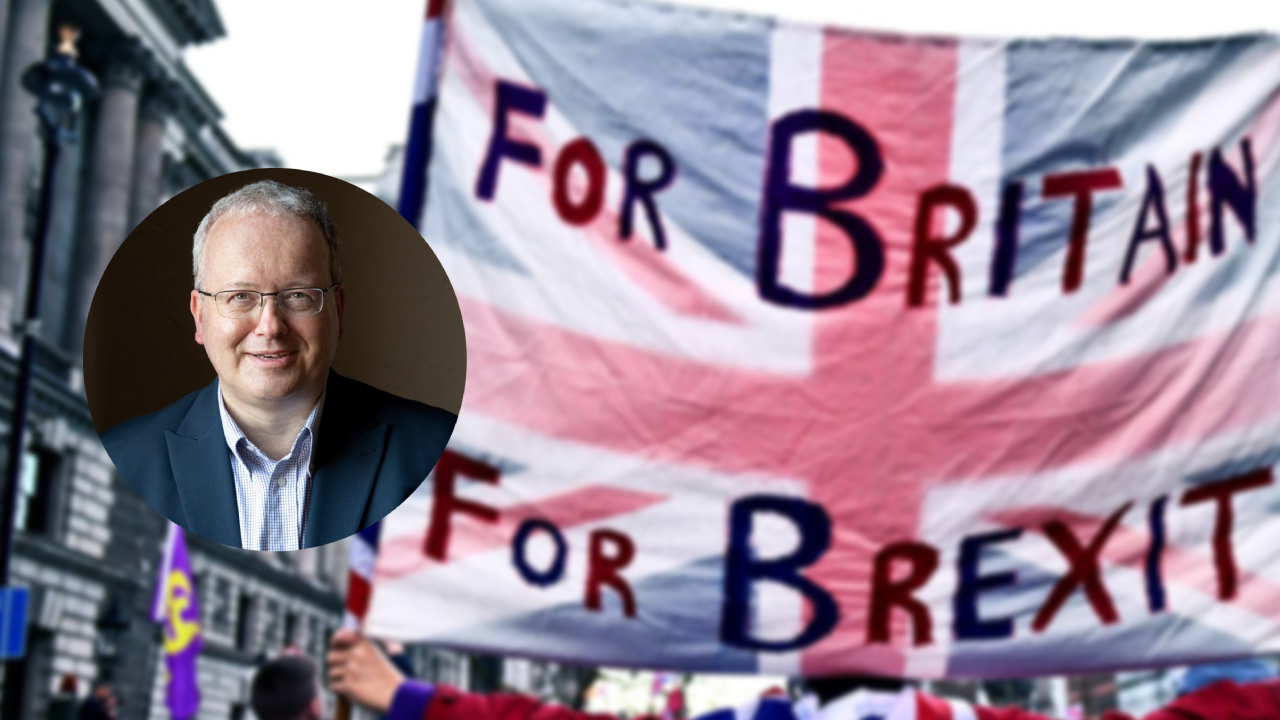
Was Brexit really a sudden, populist shock, or was the writing on the wall for decades? This week on International Horizons, Eli Karetny sits down with award-winning cultural historian Prof. Iain Quinn to discuss his forthcoming book, Cultural Dissonance: Brexit Reconsidered. Quinn dismantles the narrative that Leave voters were simply misled, arguing instead that the referendum was the inevitable boiling point of a deep, historical distrust in Westminster and the media. From the decline of serious policy debate to the modern reimagining of political parties like the GOP, this episode offers a profound new lens for understanding the ongoing democratic fragmentation in the West.
Get Cultural Dissonance: Brexit Reconsidered here.
Transcript
Eli Karetny 0:01
As populist movements in the US and Europe gain traction and deepen the anxieties of Western elites, we look back to the Brexit vote, which commentators and critics continue to puzzle over. As the 10th anniversary of the referendum approaches, it is now possible to see how commentaries before the vote and in its aftermath were rooted in flawed assumptions and ingrained bias. According to a new book, the Brexit shock contains its own important story. When contemporary opinions are coupled with cultural history, the referendum result, says the author, was completely predictable.
The shock was the result of deep misunderstandings among commentators. Brexit not only exposed the divide in British society concerning EU membership, but revealed a profound disconnect between politicians, the media, and the public. Welcome to International Horizons, a podcast of the Ralph Bunche Institute for International Studies that brings scholarly and diplomatic expertise to bear on our understanding of a wide range of international issues.
My name is Eli Karetny. I teach political theory and international relations at Baruch College, and have for years been the deputy director of the Ralph Bunche Institute at the Graduate Center of the City University of New York. This year, as the Institute’s interim director, I have the honor of hosting this podcast.
Here with me today is Professor Iain Quinn, author of the forthcoming book Cultural Dissonance: Brexit Reconsidered, which is the first study to show how a combination of cultural history and contemporary politics produced a Brexit result that should have surprised no one. Iain Quinn is an award-winning cultural historian, musicologist, organist, and composer who has worked on both sides of the Atlantic for the past 30 years with more than 100 publications, including four books. His research is focused on the intersection of politics, music, literature, and religion. He is a professor at Florida State University and an honorary research fellow of the Royal Academy of Music. In 2024, he was elected as a fellow of the Royal Historical Society and the Society of Antiquaries. Welcome, Iain Quinn. Thank you for joining us on International Horizons.
Iain Quinn 2:29
Thank you. It’s a great pleasure to be here.
Eli Karetny 2:32
Iain, your book argues that Brexit was predictable when contemporary politics is read alongside decades of cultural history. The referendum was more a reflection of longstanding public distrust at Westminster rather than short-term populist persuasion. The key argument you make is that the vote was a confidence test in Parliament and political elites, and claims that voters were misled or ignorant are flawed. Can you explain your case that many voters actually acted from lived experience and entrenched skepticism, and not because of political persuasion?
Iain Quinn 3:13
Thank you. I think with Brexit, you see a dynamic that leans heavily towards the past, but not in the way that was popularly portrayed, with Brexit supposedly being driven by Little Englanders. Whether it’s a frustration with successive parliaments, especially since the 1970s, a remembrance of a better time, or a simple belief in the importance of accountability and the British value for fairness, Brexit demonstrated that there was a significant disconnect between what Parliament expected and the response they received.
The idea that voters were misled or ignorant, I think, is quite flawed. Although it’s a typical political tactic that we’re now seeing increasingly used: instead of making the case with issues of policy, you criticize the value of the voter at an extreme level. You say that they’re not patriotic or don’t have the country’s best interests at heart. But if the people who voted to leave felt they had been lied to, there can be no doubt that they would be the first to call for another referendum, whereas the people calling for another referendum are those who lost the first time.
The lived experience that, yes, brought about what can be seen as an entrenched skepticism was not simply a post-industrial collapse that was hard-hitting for many communities in the 1970s and 80s, but an awareness of the remoteness of Westminster to individual concerns. Margaret Thatcher had effectively removed the power of the unions, and as Tony Blair had moved the Labour Party to the center—which was indeed a very successful move from a political perspective—this created a double punch in terms of the balance of political arguments. Two right-of-center parties have far less to debate, and once you then embrace the world of spin and highly controlled communications, the public eventually does not witness debate on their behalf, so much as becomes an irritated observer.
The substance starts to drift away. Especially as politicians are increasingly managed through the communications world, the debates are either carefully measured or have the tenor of a school debating society, which is where I think Parliament is now. But it’s not mature politics with overarching long-range plans for the country and a sense of vision led with strong leadership. I think to say that Brexit was caused by those who were ignorant or misled shows a particular failure of self-examination and an extraordinary lack of awareness. To suggest it only reinforces the belief that there is a constituency within Westminster and the media that is woefully out of touch.
I would add that, in terms of political persuasion, in the case of David Cameron, who had never been an ardent supporter of the EU, you cannot expect the public to assume there has been some sort of Damascene moment of realization about its value and simply go along with it. At a certain level, it’s just not believable, and the public knew that.
Eli Karetny 5:54
Thank you, Iain. Part of your argument is that Brexit was predictable because of a decades-long cultural distrust of ruling elites, both the media and the political class. Can you give specific examples that most clearly illustrate how that distrust formed and persisted?
Iain Quinn 6:16
Yes, one of the inevitable factors in democracy is that everyone voting has had a slightly different experience of the country, and that includes the range of political differences they’re familiar with, and the competency of respective leaders. Historical distance also has an impact in this respect. Someone who lived through the years of high unemployment in the 1980s will have a different view of Margaret Thatcher than a young conservative today, who tends to see her as a powerful leader that helped regain an international presence for the country, whether in relation to the end of the Cold War, the friendships with Reagan and Gorbachev, or the Falklands crisis, for that matter.
If you live in a community that was devastated by the decisions about post-industrialization and now watch news reports about the lack of an energy strategy and the reliance on Russia to keep the lights on across Western Europe—an issue the EU is similarly struggling with—it’s only reasonable to doubt the level of competence in Westminster. The same could be said over the privatizations of national industries, which now still require subsidy, and so the public isn’t in control of them, and yet they’re still having to subsidize them.
Similarly, if you’re a young married couple that has worked full time and yet cannot afford to rent somewhere to live in London without sharing a house with others, let alone owning property, and so you choose to move abroad, then, irrespective of your views on whether, in theory, the EU might be beneficial for the UK, you’re simply not experiencing it. Nor will Remain campaigners be able to make that case for you. And that’s a critical point, is that there wasn’t a strong case made for the EU.
But there’s also a key lived experience that challenges one of the populist Remain arguments. The UK has been a diverse society for the entire lifespan of those who were voting. There have been individual issues of unrest, but overall the UK is a proudly multicultural society. The lived experience of this has been overwhelmingly positive, and so the suggestion that those who were voting to leave the EU were predominantly bigoted doesn’t align with reality. It’s a superficial and potentially irresponsible argument. The Channel 4 journalist Jon Snow made this point very well in his book, saying that by comparison to the divisions he sees in other societies, he is proud of the diversity he sees in the UK. I’d agree with that, and so the idea that the public was going to believe descriptions of themselves they knew not to be true was very short-sighted and continues to backfire.
Eli Karetny 8:43
Thank you. In thinking about media elites and the political class, how do you assess the relative impact of media culture on one hand versus political actors on the other hand in creating the disconnect that you described?
Iain Quinn 9:01
I think this needs to be seen in context, and so you could fairly say that a marked change comes with Tony Blair’s time in office. He was experienced in Labour politics and had seen the strength of debates within the unions growing up, and knew the culture of the left of the party. Labour had been unelectable since 1979 before he effectively transformed them, albeit with tough decisions already taken by Neil Kinnock, and inheriting a strong economy from John Major. But with the shift in policy towards the center, you also saw a parallel reimagining of communication with the press, and in turn the public. You cannot take a trip on public transport in Britain without seeing someone reading a newspaper, and Blair’s early connection to Rupert Murdoch should never be underestimated.
However, Blair was also an exceptional political figure with considerable gifts as a speaker and a youthful energy that suggested to many that the UK was on a confident path towards the future. The Good Friday Agreement in Northern Ireland had been signed in 1998, again with the groundwork owing much to Major, and alone was a significant achievement for Blair. For my generation, who grew up watching almost daily news broadcasts about bombings in Belfast, or in a major English city, this was a turning point. The relationship with Bill Clinton was strong, and yet different than Thatcher and Reagan, and all of this spoke to a confidence that was very much at the heart of the Blair political dynamic.
But with Iraq and the so-called dodgy dossier, the question of spin and manipulation of the public cast a veil over much of what had been quite strong. Blair had an affable quality and an excellent director of communications in Alastair Campbell.
The stage beyond that would be Cameron, who had been a special advisor, rather, and worked in the media, but he lacked the same easy charisma, and to one of his ministers, Rory Stewart, a certain seriousness. It’s often commented that Cameron wanted to be Prime Minister much like someone wants to be head boy, and the fact that he resigned from Parliament after Brexit, rather than continuing to serve his constituency as he’d suggested, I think speaks to a certain shortcoming. He had never been a strong supporter of Europe, and then seemingly not overly interested in Parliament either, and that all does damage.
As such, it’s the fact that media strategy and political strategy are hand in hand. And though that may seem obvious, it’s until you say, “Where is the policy strategy in this?” and that’s what the public observes in terms of reforms that could change this. I think there’s much that could be achieved, and it’s not the decline that many speak of.
Let me speak to one particular point. We’re all very aware of the challenges to the arts and humanities when funding runs out, but the current political climate shows that we do that at our peril. It’s not just about funding projects, but about having multiple voices in debates, so that the arguments are far stronger. The media and much of the political world operate on short timelines that inhibit creativity, whereas flexibility and ambitious thinking is what the arts lives in. Creative solutions that are new, innovative, and potentially challenged are valuable, so that the outcome is a superior one overall.
If you look at the humanities, the world of history now under serious threat in UK universities is critical, especially when it concerns security and defense. If you don’t understand both the history and the cultural environment that surrounds decisions, especially geopolitically, you will reliably fall short. A central question is not what your adversary does, but how they come to that decision. And in relation to restoring trust in politics, I would say this all relates to a lack of seriousness that the public perceives. It very often looks quite amateurish compared to other aspects in life, and in the UK that’s more exposed because there’s a greater dependency on the state. I would also say that public trust would be regained in part by witnessing a greater degree of competency that doesn’t hide behind carefully crafted statements, and instead showed confidence that comes from the strength of arguments that the public know to be valued.
Finally, I would argue that it’s interesting to see the emergence of so many political podcasts since 2016 and on both sides of the Atlantic. I note in the book how the long-form political interview has largely disappeared on television, and indeed, when it rarely happens now, it tends to be in a rather gentle exchange with an agreed line of questioning. The political climate is still quite allied to the 24-hour news environment, not least with online messaging, but news every minute without the time to seriously think on it doesn’t present the same impression as a daily broadcast, where there are some hours to prepare and consider what the outcomes of a particular development might be. However, I think if politicians engage more often in one-to-one conversations like that, it would be an interesting return to an older model that’s happening more, and it’s certainly to the good.
Eli Karetny 13:57
I appreciate that, and I appreciate your time, and, you know, thoughtful answers on these issues, rather than the kind of sound bite culture that you describe. I want to shift the conversation to the identity issues tied into discussions about Brexit. You emphasize that local civic institutions and community networks are central to identity. What lessons are there for commentators who misunderstand populist movements in the West by treating them as primarily a nationalist phenomenon?
Iain Quinn 14:42
Do I think one aspect of this is the question of how we interpret populist and popular? As the first tends to have a negative connotation, and for many infers a superficial aspect, whereas the latter is positive. The disconnect with the media and in turn politicians has come from the idea that globalism, with it a certain uniformity, is what people want, as opposed to what they’ve been provided with. That suggests we’re all the same, or willing to be, which is, of course, false.
I would say the UK has a very special identity when it comes to local and community networks. It’s a culture of clubs and societies with a lot of people engaged in hobbies or other pursuits on a regular basis. It is still very largely a society that stops work at the end of the business day and assumes that weekends are for leisure. You see this especially in the role of volunteers in large institutions. A cathedral is a very good example of this, with a dozen or more groups engaged in activities every week, and each with a certain independence, and all voluntary.
But there is also a political dimension to this. When you see the annual Miners’ Gala in Durham continuing long after the closure of the mines that provided the initial association, it shows that the bonds of community are extremely strong. And in turn so is the nature of interaction; people are frequently discussing politics at one level or another, reading the newspapers, and you could argue engaged with the debates.
There’s also the larger community identities, such as the affinity for the royal family, where there’s a relationship that crosses all sorts of demographics and far exceeds loyalties that are political or related to popular culture. Individual groups and national points of affinity reinforce confidence, and within that realm, it’s also easy to see when politicians or the media can relate to the public or when they’re simply trying to manipulate through messaging.
Eli Karetny 16:35
That’s great, and it reminds me of important arguments made long ago by Alexis de Tocqueville and contemporary Tocquevillians like Robert Putnam here in the US making similar arguments about the importance of civic institutions, and at least in the US, regrettably the waning importance of such institutions. Shifting to the immigration issue, many commentators frame Brexit as driven by immigration anxieties or nostalgia. However, you come to understand those explanations as secondary to the issue of political competency and economic insecurity. So can you explain how it is then that immigration has been misunderstood, or the lessons of Brexit have been misunderstood in terms of the immigration issue?
Iain Quinn 17:36
Yes, I think the evidence is quite interesting. If you look at the books that appeared initially after the referendum, there’s a great divide, although largely towards criticizing those who voted to leave. So, when we consider commentators, we also have to look at what it means when most of the commentators did not share the views of most of the voters. Indeed, many were quite bitter. Again, that’s not a policy debate, but an emotion, and one that was often expressed with insults about other people. In turn, that raises the question of substance to arguments. If, when it comes to sitting down and writing on a topic, that rage is still there, it is in every sense a commentary, not an analysis.
Now, personally, I had started writing this book in 2016, and then as others started to emerge, the larger picture changed in the overall research. The views that people had felt about Westminster and the disconnect that was present with the media was actually being reinforced. The overwhelming tone of many writings was, “We don’t care what you think or how you vote, because you’re wrong.”
In terms of immigration, I mentioned the nature of the UK being welcoming to immigrants over a longer period of time, and the value of a diverse, multicultural society, but immigration related to Brexit through a specific lens was something politicians had long chosen to avoid, and in part because they couldn’t provide a solution. The question is not whether the UK is opposed to immigration, because we know historically that has not been the case. Rather, the question is whether the government could control the number of immigrants.
Calling people xenophobic if they oppose leaving the EU was a shallow argument to deflect from other issues of competence. But after the Maastricht Treaty in 1992, it became impossible to control the flow, and as the EU continued to expand, that flow became more and more difficult to restrain. In part, it should be noted, because the UK was perceived as being welcoming to immigrants, it was an appealing place to move to and to work. But also no strong case had been provided by the government about the benefits of the EU, which to many seemed oddly local. A new art installation, or another seemingly highly particular piece of funding for one community that, meanwhile, hadn’t recovered from cuts during the Thatcher years, and felt that New Labour under Tony Blair no longer gave them a voice, was quite unconvincing.
I would say there’s no evidence to suggest that there was an overriding concern about economic security, because those decisions would still rest with Westminster and not the EU as such. When people talk about taking back control, it’s in part removing the EU as an excuse for politicians to rely on. In this respect, with the economy in a dire situation now in the UK in 2026, it’s interesting that there’s talk of rejoining the EU, although no argument for why that would improve the standard of living. Looking back a decade, if you were already disadvantaged while being in the EU, how would your situation worsen outside the EU? In turn, what would be the argument for rejoining? And that’s before you raise the topic of trying to reverse a democratic vote.
Eli Karetny 20:43
Interesting, interesting. How you describe the economic and social drivers relating to declining living standards and regional grievances, and the general sense of somehow being left behind. Looking forward, I want to explore the practical lessons. What lessons should the current government in England and political parties in Britain and really throughout the West take from your findings to reduce the risk of democratic fragmentation?
Iain Quinn 21:20
I think if you consider the rise of populism, there are two critical factors: firstly, the belief that a specific person is authentic, relatable, or believable; and perhaps more critically, a weak political defense to that that allows populism, if a negative connotation is inferred, to emerge. Did Brexit happen because of a strong argument? I would say no. It happened because there wasn’t a compelling counter-argument, and the fact that the referendum was called to calm Eurosceptics within the party of the sitting government meant that the rationale for the referendum was flawed from the outset, because it was quite obviously a political maneuver.
But populism is also calculated on the short term like the culture of celebrity. Eventually, either the mask comes off or another figure has to emerge to challenge the central arguments that have for a time been successful. Democratic fragmentation can happen in the form of coalitions, which can be a healthy model, although by nature responsibility is divided, and that is harder to monitor. But I think the greater issue is the need for long-term planning that shows a far greater understanding of cultures and communities within countries, and also of other countries.
If people are divided because of a political advantage, that will ultimately be a weakness to the whole. Countries are far stronger when they’re not polarized, especially if they have been used to a healthy democracy. It’s not just that others view polarization as a weakness to democracy, but that it causes congestion that impedes progress. Populist arguments, short-sighted policies, or a dependency on fast transactional relationships end up missing a great deal.
I would say that reform comes with expectation, and change can come quickly. One of the current debates is whether the right problems have been identified, but have been attached to the wrong solutions. For reform to occur, there will need to be leaders who will be challenged strongly by political opponents through policy arguments, and a related network around them that achieves that. Supporting scholarship, research, and higher education are central to progress, because you must know what the larger arguments and cultural contexts are.
I think the most immediate reform that’s needed is a reform of expectations, but I would also say that looking at the political climates on both sides of the Atlantic, it’s a matter of identifying what those climates currently are, and to see that they have shifted. And in some respects it’s easier to, because the British political climate changes very, very rapidly. There have now been six prime ministers, including David Cameron, since Brexit, whereas the American system works more slowly in terms of change.
But you see, for instance, in the States, much as you saw with New Labour with Tony Blair, a reimagining of a party, and with the GOP, you see a reimagining of that party. Not a new party, but a reimagining of it. And unless the other party takes acknowledgement of that and reimagines itself, then you end up with this stalemate and a resulting lack of progress that goes along with it.
So you could say that in the States, MAGA is in essence the new GOP, the same way that New Labour was the reincarnation of the old Labour. And they’re very different political ideologies, obviously, but the idea of reimagining the party, the other party then has to see where it stands and see what its arguments are going to be, and until that is in place there. Fundamentally, you have a weaker system because there’s less progress, because democracy thrives on a certain friction. The energy comes from that traction that is enabled by debate and by indeed scholarly engagements, having experts involved who can put things in context. Without that, it’s just a slower process, and indeed it’s your adversary, if we’re in that language, is able to drift right past you, because there is a degree of friction. Either that or because they have a system that involves complete control. But when you’re in a democratic environment, I think that friction becomes vital, because otherwise you miss a lot, because you’re not being argued with.
Eli Karetny 25:43
That’s a fascinating point you make about MAGA being the reimagining of the GOP, and I wonder, you spend a lot of time, you live in the US, if you could say a few more words about the political dynamics from your vantage point here in the US, and maybe about how the lessons from your book could apply. What I have in mind here is the disconnect that you describe between the public in Britain and the political elites, and to what extent MAGA is a response or reaction to a similar kind of parallel disconnect here in the US, and how does that reimagining play out? If you can kind of read the tea leaves.
Iain Quinn 26:41
I think that the language used here is quite different in the States, but I think it’s important to follow it, because it is genuine, because it follows through. When people talk about a new type of politics, they’re not saying a new type of policies that they’re considering. And what, in the case of the States, I would say that the Democrats need to be aware of is that the approach to politics has changed. Hoping that there will be a few more seats and they’ll regain the House or they’ll take control of the Senate is not a policy argument at all.
And if policy can be dictated by a single tweet, no debate in Congress, no indeed second debate in the last presidential election, that tells you a lot. Not just that there was a confidence to do it, and you can argue the pros and cons of that from a democratic standpoint, but what you have to acknowledge is the public accepted that, and millions accepted that there was no need for a debate. There wasn’t an outcry that didn’t invalidate the GOP campaign, rather it was acknowledged that no, we’re going to have a different system, and that’s what it is. And so hoping that the pendulum will just swing back, which is the language you keep hearing, won’t work.
And it’s telling for me that, though it was a two-term presidency, the word that is most commonly associated with the Obama presidency is “hope.” It was not reimagining, it was not sort of, you could interpret it as a way forward, but the word was hope. And I think that is what many on the left—although the left here is far right of center compared to many other countries, there isn’t, I think, from the perspective of anyone looking at European politics, really a left at all in the States—but I think what you see still is this hope that it will change, as opposed to a set of policies.
And the remarkable thing is that all the evidence is provided for those that want to challenge. So when you have the presentation of the tariff information, for instance, and you have this visual aid—and we live in a visual age—the response to that are debates that are speaking, they are not a contrary argument shown in blunt terms. And you see the same with campaigns, of all the things that could be challenged, they are never put in a point form that is easy for the public to follow. And so there is an element of what in Britain would be called the opposition, and here is simply the party that isn’t in power, actually being in the ring at all.
This is, it’s not a system. I think it’s unfair to say the system’s been hijacked. I think that’s extreme. I would say it’s not being engaged with, and you’re not seeing a full engagement with the political process, and you could say as it has currently matured, because the nature of doing politics in the States has quite simply shifted. And either you acknowledge that and say, right, well it’s not a matter of policy in that case, it’s a matter of how you approach it and how you understand the culture.
And if you don’t understand that there’s been a cultural shift because there’s been an impatience, so you have somebody that at different times in his life was allied to both the major parties, and say, right, this is a different sort of Third Way. What is remarkable is that it’s been possible to take over a party this way, as opposed to starting a third party, which is what you would generally see in European politics. A third party would emerge, and then you’d end up with a coalition, but that third party would have some power in the system, because they would always need the votes.
Eli Karetny 31:08
Thank you very much, Iain. Make excellent observations, and the lessons of Brexit should be revisited, reconsidered, as you say in your book. I wish you good luck with the book. Thank you for joining us on International Horizons.
Iain Quinn 31:25
It’s a great pleasure. Thank you.