Podcast: How is the State Surveilling and Manipulating us These Days?
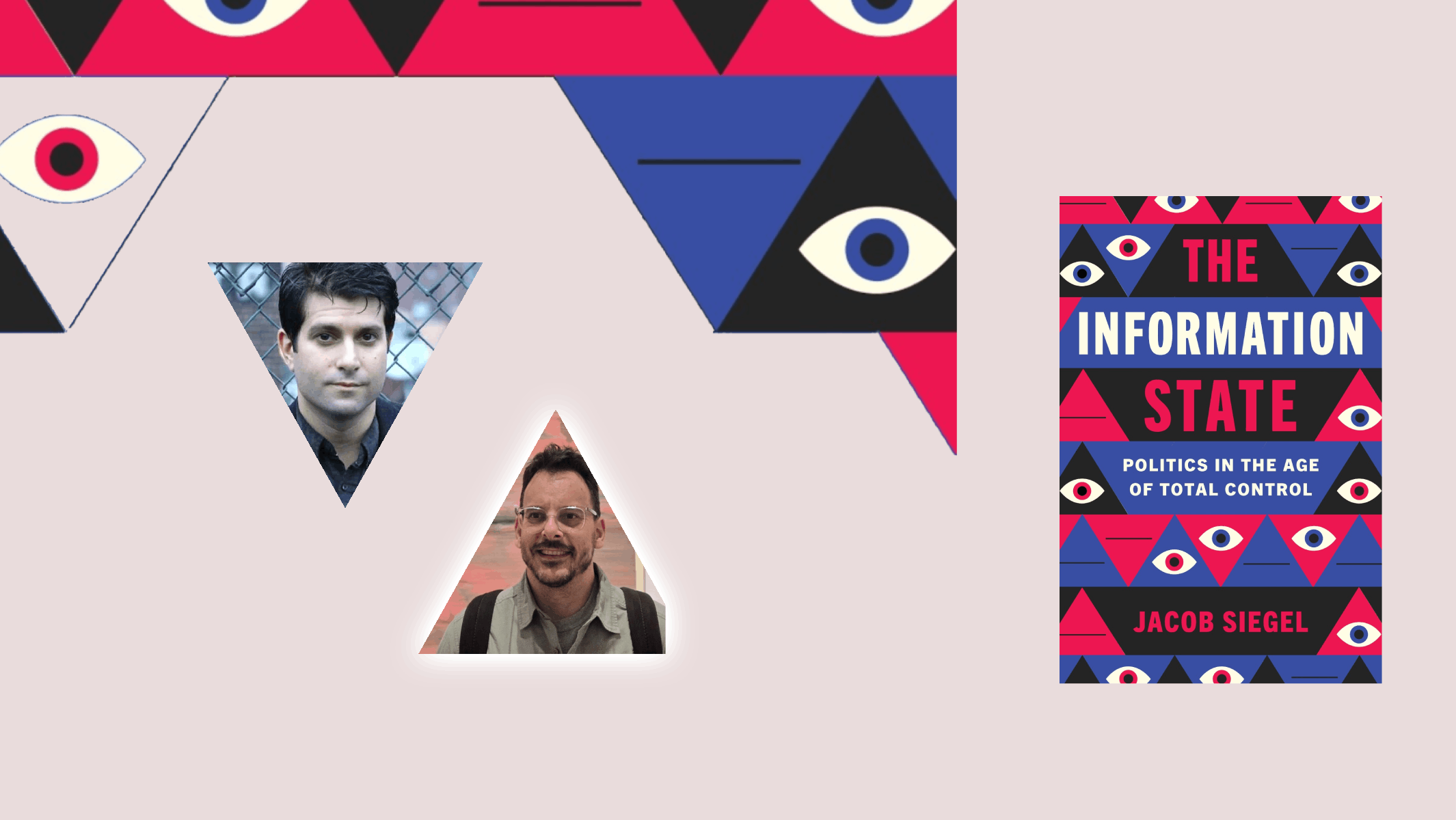
In this episode of International Horizons, RBI Acting Director Eli Karetny interviews Jacob Siegel, writer, Army veteran, and author of The Information State. Siegel traces how military information operations, post‑9/11 surveillance programs, and Silicon Valley’s rise converged to create a new public‑private regime of control over information, attention, and consent. He discusses the intellectual roots of technocratic governance from Francis Bacon and Leibniz through progressivism, World War I propaganda, and cybernetics, and explains how the “information state” differs from classical authoritarianism. Finally, Siegel reflects on Trumpism, the tech counter‑elite around figures like Elon Musk, and how AI may usher in a more “Pharaonic” and quasi‑spiritual form of politics beyond traditional expert‑driven technocracy.
Transcript
[0:00:04] Eli Karetny:
A new regime is upon us. Democratic consent has been replaced by new systems of control, which operate through codes, protocols, algorithms that determine what we pay attention to, how we form opinions and even how we experience our social reality. Data is censored, narratives engineered, and this new form of control is totalizing. The information state is here.
Welcome to International Horizons, the podcast of the Ralph Bunche Institute for International Studies that brings scholarly and diplomatic expertise to bear on our understanding of a wide range of international issues. My name is Eli Karetny. I teach political theory and international relations at Baruch College, and have for years been the deputy director of the Ralph Bunche Institute at the Graduate Center of the City University of New York, this year as the institute’s interim director, and have the honor of hosting this podcast.
Here with me today is Jacob Siegel. Jacob is a writer, Army veteran, the Special Features Editor at Tablet magazine, the co‑host of the Manifesto podcast, and the author of an important new book called The Information State. Jacob was also an editor and contributor to Fire and Forget: Short Stories from the Long War, an anthology of short fiction by Iraq and Afghanistan veterans.
Welcome, Jacob. Thanks for joining us on International Horizons.
It’s good to be here. Thanks.
Let me begin by saying, the book is excellent, really insightful, sharp, beautifully written. Whatever your politics, there’s much to be learned from this book. So from what I understand, Jacob, the project began with an essay you wrote for Tablet magazine focused on a critique of counter‑disinformation. But the book goes way beyond a critique of censorship.
Can you tell us about the origins of the book? Maybe a word about what you learned from your military service about efforts to combat disinformation in the global war on terror, and how you came to expand the critique beyond censorship and a concern with free speech to look at questions of political agency and sovereignty.
[0:02:27] Jacob Siegel:
Well, thank you for that. So, your questions dovetail, because the origins of the book really go back to my experiences when I was deployed with the US Army to Afghanistan in 2012, and I was an intelligence officer serving in an infantry battalion in western Afghanistan, which was a part of the country at that point that had mostly been turned over to Afghan national security forces. So we were actually the last conventional American combat unit in western Afghanistan. There were still special operations guys running around, but we were the last show in town in what was supposed to be this progressive transfer of responsibility for security and governance over to the Afghans.
And what that meant was that my unit had basically a much larger‑than‑standard package of intelligence and surveillance assets, because we were sort of the last show in town. And what that meant for me as a battalion intelligence officer was that I had this extraordinary, almost futuristic, incomprehensibly powerful array of surveillance and data technologies at my disposal, and yet I still couldn’t figure out what we were trying to accomplish. It didn’t seem to make any sense. The essence of the American mission at that point struck me as somewhere between delusional and incoherent.
And it was this disjunction between the strategic gap, this strategic incoherence, and the all‑powerful technologies that first got me thinking about the aims and uses and ultimately the teleology, but also the limitations of these information technologies. And you know, why it is that these information technologies – one of which was Palantir, which is now, you know, much discussed, both in news reports and also in kind of, you know, theories of world control. And I used Palantir in 2012 and it was awesomely powerful. It didn’t really help us defeat the Taliban at all, though, nor did it help us to create a functioning, coherent civil society in Afghanistan.
So that was the beginning of it. Then I got back from Afghanistan, and one of the first things I noticed when I got back to the US was that internet culture had become the culture, and I hadn’t really picked up on that before I left. But not long after I returned to the US were some of the early stirrings of Anonymous. You never really hear about Anonymous anymore, but it was a kind of big news story at the time. It was almost like a ghost story. Was it a prank? Was it, you know, a premonition of some strange new future? It was this group, they wore these Guy Fawkes masks. They did troll pranks like attacking Scientology. They had some connection to 4chan. What exactly was 4chan? It was like, was 4chan a hive of Nazis? Was it all a joke? And I didn’t know. I was trying to sort that out.
And then, very quickly, as I was trying to sort that out, the questions I was trying to explore – not even really attempting to solve, but just probing at the time – started to intersect with these huge eruptions of social protest and social discontent. Anonymous obviously had connections to Occupy Wall Street, but then there were these series of interlinked protest movements that started not long after I got back in Steubenville, and the Black Lives Matter protests in Ferguson, etc. And the internet played a key role in all of those as well.
So that was, that’s the kind of deep backstory to all of this. Then if you fast forward to 2016, 2017…
[0:06:51] Jacob Siegel:
…the immediate prompting for the Tablet article that led to the book was this sudden, ubiquitous use of the concept of disinformation, which just struck me in the first order as being remarkable for how quickly it had spread and been accepted as the dominant master narrative of American politics. And as I say in the book, I don’t think you could have really found more than a handful of people who could have intelligently articulated what disinformation meant in the contemporary context, in, let’s say, 2014, because at that point it was still a term that was a kind of relic of the Cold War.
But then all of a sudden, this Cold War relic became the master narrative in American politics, and I wanted to figure out what that meant. And the first step in figuring out what that meant was this big article that I wrote for Tablet. It was a 13,000‑word essay. It was like, you know, the length of a novella, essentially, really detailing the origins of this extraordinarily powerful counter‑disinformation establishment that had claimed, first of all, had constructed this sprawling public‑private apparatus, with federal agencies, social media companies, and nonprofit groups all brought together in what they referred to as a “whole‑of‑society” configuration.
And finally, the last stage was that as I began to unwind this new form of power, which pretty quickly I realized was not simply a tool of censorship and of political coercion, but was a form of government itself. That the censorship was only this sort of the crudest manifestation of what aspired to be a mode of government – a government through algorithmic control and algorithmic expertise and adjudication, algorithmic adjudication.
And then I looked into the origins of that, and that took me back to World War One and the origins of progressivism. But beyond that, it took me all the way back to the 17th and 16th centuries and the origins of the scientific revolution and Francis Bacon and Gottfried Leibniz. And I’ll stop there.
[0:09:23] Eli Karetny:
That’s great. Thank you. Thank you for setting the stage. And let’s, let’s jump into that. You know, I want to explore that trajectory, essentially a kind of a sweeping story of modernity itself, the key thinkers, key kind of mindset.
But let’s, let’s take a step back and take a look at what you just said, which is that what began as a kind of a thorough analysis and critique of counter‑disinformation turns into something much more. It turns into a theory that we have upon us a new form of political regime. That’s a fascinating take, and part of the argument is that this is neither classical authoritarianism nor modern liberal democracy, but essentially a kind of a technocratic apparatus that governs by controlling information flows, attention, the digital public sphere.
And you describe this in the book, and as you just eloquently did here, as kind of stemming from a spillover from military efforts to control the information domain on the battlefield into civilian life. And then this gets fused with the rise of Silicon Valley, and the apparatus essentially is – tell me if I’m right here in the way I’m framing this – a public‑private infrastructure that shapes beliefs, suppresses speech, engineers consent, and administers society, you know, at scale.
It is a new control system, produces, to my mind, a hierarchical form of order. It centralizes power, it erodes democratic consent, and it seems to generate recurrent crises that it can’t solve. So there’s a question in here somewhere, and I guess the question is: where did technocratic management of democracy, which began, in your telling, as a progressive project in the Wilson era – where did that cross the threshold into a new political regime, and what makes that new regime qualitatively different from authoritarian systems of old?
[0:12:00] Jacob Siegel:
So the technocratic approach to government actually precedes progressivism – capital‑P Progressivism – by a bit, because you start to get the first emanations of technocracy as an approach to organizing society before it has a pointed ideology, and that’s in the sort of positivist movement and, you know, Henri de Saint‑Simon, and these early thinkers who sort of bridge the gap between Francis Bacon – the Baconian worldview – and industrial society.
Because the germ, the conceptual germ of technocratic government, has been around for centuries, but it can’t be instantiated until industrialism regiments the material base of society in a way that the technocrats can administer. In other words, there is an idea that society can be scientifically organized, that the empirical method, that the extension of scientific technologies, ought to be applicable to the rationalization of human activities as well as to inorganic activities. That precedes technocracy proper.
And it’s important to understand because the, you know, one of the stories I’m trying to tell in this book is the way that ideas and technological developments wrap around each other, play out in this kind of mutual formation, where the idea can be present, but requires the technology to actualize it. The technology both advances the idea and also changes it in some essential way that the people who had been the advocates of the original idea couldn’t have predicted, and there’s some unintended consequence.
So the big leap, as you point to, is progressivism, because progressivism is a response to the crisis of industrial society. And there are a number of responses to the crisis of industrial society. Communism is one of them, anarchism is one of them, and progressivism is one of them. And the progressives, in fact, see themselves in part as the reformist option that will preempt – in America, I’m talking about the American progressive movement – sees itself as a reformist option that will preempt the more radical movements of anarchism and socialism from gaining power and leading to class war and a revolution.
And the way that they approach the problem of society is not principally through class antagonisms. You know, they approach society principally as a management problem. Industrialism has gotten too complex. This complexity is poorly matched with the democratic basis of society. The average people should not really be able to exercise a veto over the experts. I mean, Woodrow Wilson, as I write about in the book, is very explicit about this, is very explicit about seeing the Constitution as a kind of antiquated impediment to the proper administration of society, which requires stepping over this folk religion of public opinion and setting up a new infrastructure whereby the experts can – the experts still have to deal with the public – but rather than submitting themselves to a veto to the public’s vote, now the experts are going to generate this new machinery to give the public the right opinions, so that the public will ratify the decisions that the experts have already made.
That’s there as an idea, and then it gets actualized and institutionalized in the First World War, most explicitly. There’s a general state of emergency, a general state of exception, as happens in wartime, and that idea gets actualized in its most sort of pointed form through the first American propaganda office, which Woodrow Wilson creates, which is called the Committee on Public Information. And a leading candidate to head the Committee on Public Information – this is an interesting side note – was the famous intellectual Walter Lippmann, who later wrote Public Opinion, his seminal work, and who gave the phrase, who wrote the phrase “manufacturing consent” that was later picked up by Noam Chomsky. So Lippmann, who came up with the phrase “manufacturing consent,” was also in the running to head the first American propaganda office.
[0:17:19] Jacob Siegel:
So that’s there at this sort of expert‑led administrative government, relying on propaganda and censorship, is there. But the technological means and the residual American political culture and the attachment to local culture in particular all mitigate its power. And there are currents and there are counter‑currents.
I think the New Deal introduces actually quite a different approach to democratic government in America and to the question of how you deal with administering such a vast society. And the New Deal approach has more to do with the sort of corporate model, where you bring different representatives in who speak for different segments of society in the sort of labor board model, and then they hammer out some sort of common good negotiation under the tutelage of a powerful executive. And that’s the model of the Democratic Party up until the Obama years.
The change that you’re asking about – when does this go from being just the sort of natural progressive reliance on administrative power and on technocratic expertise, when does it cross the threshold into this new form of political regime that I’m describing as the information state? There’s a very short direct answer, which I’ve taken a long time to get to, and it’s 9/11. It happens, the beginning is the Global War on Terror.
Because what happens in the Global War on Terror is that the internet effectively gets renationalized in part. The internet, which had begun as a project of the Pentagon, as a military project, then was privatized and became what we now know as the commercial internet. Now, after 9/11, it gets brought back under the government – but not officially and not exactly. And the most audacious attempt to bring the entire internet under the auspices of the government in response to terrorism takes place very shortly after the attacks of September 11, 2001, through this program called Total Information Awareness, which comes out of the DARPA agency in the Pentagon, which was the agency that had originally developed the internet itself.
DARPA, after 2001, heads up a program called Total Information Awareness, which proposes to take essentially every scrap and iota of data that is produced by human beings, not only in America, but actually across the world to some extent, to collate all of this data – to take commercial bank transactions, library books that have been taken out, records of library books, facial biometric scans – and to put all of this into what it calls a “system of systems.” And that system of systems will analyze all of this data about human beings across the world, and after analyzing it, the promise is that it’ll be able to predict future terrorist attacks.
Word about this program leaks to the press quite quickly, and in 2002 it’s officially shut down. But what ends up happening is that the functions of Total Information Awareness – the office is shut down, but the mission is just distributed among different government agencies and the private social media companies, who now do the work of collecting all this information that was originally going to be funneled into this very overt program of governmental quasi‑omniscience, with the, you know, the very brazen name Total Information Awareness.
But now, okay, it gets a bit more subtle. It gets a bit more decentralized. But the essential characteristics are still there. That infrastructure, which is the beginnings of this private‑public infrastructure, surveillance infrastructure that you described, then gets combined under the Obama administration with the Democratic Party machinery, because Obama effectively inaugurates this alliance of the Democratic Party and Silicon Valley.
And, you know, the symbols of this are very prominent in his 2008 campaign. You know, he’s constantly doing campaign stops where he’s presenting himself in this way. He goes to Palo Alto numerous times. Eric Schmidt, the head of Google, is campaigning for him.
[0:22:19] Jacob Siegel:
You know, none of this is happening in secret. It’s part of his appeal at the time in 2008, that he’s running as the kind of Silicon Valley internet president. He takes this surveillance infrastructure, which now spans both the public and the private sector, and he’s able to bring it under the direction of the Democratic Party and to merge it both with the machinery of the party and with the nonprofit complex, so that this surveillance – military surveillance infrastructure, which had been directed initially by the government to deal with foreign terrorists – can now be used in part to effect domestic social programs, progressive programs, to help administer health care, to help promote new equity policies of the government. That happens under the Obama administration.
And then in its final act, Obama, in response to the rise of Trump, creates out of these parts this officially deputized counter‑disinformation establishment, which is built out of the bones of the counter‑terrorism establishment. And that counter‑disinformation establishment now can enact sweeping surveillance and censorship across the entire society in ways that can remain invisible – either for years, until they’re discovered or outed in a legal case, or can persist indefinitely and we simply never know about them.
So the difference in kind between the society we’re living in now and previous authoritarian regimes is both its scope and pervasiveness – the fact that virtually every aspect of your life has to pass through the apparatus of the totalizing information state. Whether or not that state is coercing you in any direct way at any point of interaction, you must pass through it. So the zone of private space open for voluntary association – you know, what Hannah Arendt believed was the essence of liberal society, was the zone of non‑compulsion – is essentially not always actively intruded on, but is always… is captured, is fully captured, and exists only theoretically, but can be instantaneously revoked, continuously revoked, fractional second to fractional second, by the controllers of these opaque algorithms who determine the edifice of reality within the digital public square.
[0:25:16] Eli Karetny:
Wow. I want to connect some of these dots and then take it to another level – the story, the fascinating and very complicated story that connects key historical moments, key wars, political actors, policies, technological developments, the kind of the ethos of technocratic administration on the part of an elite class. There’s a sense in which these are the events that are unfolding that culminate in the information state.
But at the level of an idea – a high level, even, it’s almost like a spiritual idea – you talk about the work of Jacques Ellul and what he calls technique. Can you talk about how the information state is, in some ways, the kind of the final expression, or maybe not yet the final expression, but an expression of what he calls the consciousness of a mechanized world? What is this consciousness? To what extent is this like the spirit of modernity itself playing out through history, through political actors, through technology?
[0:26:38] Jacob Siegel:
Ellul, yeah. No, I think it might be the spirit of modernity itself, certainly a vital component of that spirit. So Jacques Ellul develops this critique, this understanding and critique – a French sociologist active in the Resistance in World War Two, for which he is honored at Yad Vashem in Jerusalem as Righteous Among the Nations. So he was, he was an active partisan in World War Two. He’d become a Protestant, and so I think, in part, you know, he had a certain sensitivity – and France was a Catholic country – he had a sensitivity to the position of minorities in the society.
And he had a political philosophy that’s very hard to… much more French than it is Anglo. It’s hard to pin down. He called himself a Christian anarchist. I’m sure that was true, I’m sure that’s what he was, but it’s not in any way that would be, that would comport with the categories of either Christian or anarchist in the sort of American political discourse.
But he had a belief in human freedom as precious, and a belief that it was under massive assault by the force of what he called technique, which he saw essentially as the force of modernity. So what he meant by technique was something greater than the specific technological inventions which acted out technique. By technique, he meant the determination to produce maximal efficiency in everything. So it doesn’t require a physical technology, because, for instance, bureaucracy is technique applied to government and social organization.
But what technologies do is they take that idea of technique, that idea of rational efficiency maximizing as being the highest good, and they accelerate its speed and power in such a way that it becomes, if not impossible to resist, then so blindingly fast and powerful that it appears impossible to resist, in such a way that there is no effective resistance, and it simply marches on – whether what it is doing in its transformation of society is something we want or we don’t want becomes unimportant in light of its ability to make everything submit to the rule of this maximal efficiency of technique.
The connection here with information is that the physical world is stubborn and it’s full of friction. So if your goal is to introduce maximal efficiency into every process – into socializing, into elections, into transportation, into childhood education – if your goal is… and goal is not even the right word… if the drive, if the underlying drive of the…
[0:30:11] Jacob Siegel:
…the tendency towards progress, the sort of underlying metaphysical religion of progress, that we must always be progressing, means that everything has to become more rational and more efficient all the time. Then you need to create systems to organize these subjects that you want to rationalize and optimize. And so that requires information. That requires empirical data. And then once you have that empirical data, then you realize that the more the data can be speaking to other data, instead of speaking to stubborn physical objects, the more you can turn everything else into data, the better it can be controlled by the centralized data.
So information reduces all friction. It eliminates all friction. The more informationalized the world becomes, the higher the degree of maximal efficiency and optimization can be introduced into everything. And of course, what I’m describing at a very high level is a kind of, you know, spirit of the age, something like that. But I’m also simply describing the internet, right?
And so what Ellul is talking about, and this total informationalization of society, is the internet. And we don’t always think of the internet as being purely about efficiency, but at a very fundamental level, that is the engine that it runs on. The internet runs on digital networks, run on the elimination of obstacles to the transmission of information.
[0:32:00] Eli Karetny:
Thank you for that. There are two paths I want to offer you to take from there. One is: fit the trajectory from Francis Bacon to Leibniz to cybernetic theory to the internet and, you know, and the information state. That’s one kind of path I’d love to hear you say a few words about.
But the other one – and this one you can choose not to pursue – is the discussion you have early on in the introduction of John Wheeler, a physicist, who talks about the idea of “it from bit.” And this is a more foundational way of understanding reality itself, right? I have some kind of friends and researchers doing work in the simulation space, doing work on consciousness, who talk about Wheeler all the time, as if he’s the key to understanding our reality at the most fundamental level – not at the political level, not at the break from the pre‑modern world to the modern world. We’re talking metaphysics here.
So, I mean, if you want to go down that path, I’d love to hear a few words about that, but I certainly want to hear the kind of the path from Bacon to Leibniz to the internet.
[0:33:25] Jacob Siegel:
Well, I think it all fits together, because what Wheeler is proposing – and Wheeler is famous for his work on black holes and also for being one of the secondary inventors of the hydrogen bomb, before he became the sort of master information theorist – and he comes up with this phrase, “it from bit,” which means, what he’s saying there is: “it,” meaning material reality, comes from the bit, the bit being the basic unit of information.
So he’s saying that it’s not like energy and matter, no, there’s something even more essential, which is information. And information projects out the entire material universe in the same way that, let’s say, DNA projects out or manifests the physical characteristics of organic life. The information in the universe created the universe.
Now, there’s an obvious resonance here, by the way, also with God speaking creation into existence. So it is not exactly a new idea, but it’s a new idea in science in the way that it’s presented, and that has very significant – you know, it’s definitely not proved – but has a lot of foundational evidence to support it in terms of what quantum physics discovers. But let’s… I don’t know anywhere close to enough about quantum physics to even attempt to speak about this.
But how does this relate to these developments from centuries earlier? Because Wheeler and this it from bit concept is the second half of the 20th century. But what predicts this, what anticipates this, is the discovery of the binary code. And the binary code is essentially the basis of all digital technology. And the binary code is being discovered as early as the 16th century by Francis Bacon, who sort of stumbles on it in his attempt to develop a cipher.
Binary mathematics – instead of having, instead of performing mathematical computations using 0 through 10 – binary mathematics uses only two integers, two digits: 0 and 1. So all numbers in binary are represented by some combination of 0 and 1. And the discovery of this, which happens with Bacon in the 16th century, then almost immediately anticipates the invention of digital computers.
So already – I don’t mention him in the book – but Blaise Pascal also is, you know, the author of the Pensées, famous French philosopher. Pascal is also tinkering with the creation of digital computers. And Gottfried Leibniz, this brilliant German polymath, philosopher, discoverer of calculus, among many other things – Leibniz, who’s also a deeply religious thinker, a kind of mystical thinker, is interested in Kabbalah – Leibniz discovers binary code and immediately connects it to the mind of God.
Because Leibniz’s theory is that, his postulate is, that the universe must have been created with the simplest, the fewest number of principles necessary; that there’s nothing unnecessary in the universe, and so the vast complexity of the universe has to have been produced out of a small number of essential parts, essentials, essences. So when he discovers the binary code, that all numbers can be derived from 0 and 1, this seems to him to be the mind of God, and he immediately in the 17th century, like, he immediately connects this to the aspiration to build a machine that would run on this code, that will be able to compute all matters – from matters of, you know, social disagreement to arguments between people – that all aspects of the social relations of arguments over truth will be…
[0:38:24] Jacob Siegel:
…resolved through his idea to build this, essentially, you know, truth‑resolving machine. And I could say much, much more about this, but I’ll stop there, because the next great leap from Leibniz in the story I’m telling is in the development of this new theory of cybernetics immediately after the Second World War.
And cybernetics comes from a strange character named Norbert Wiener, another brilliant thinker, a child prodigy who has worked on these fire‑control problems for years at this point for the US Army. And the fire‑control problems are: how do you essentially automate the aiming of anti‑aircraft guns? That’s the problem he’s trying to solve during the Second World War.
And in the process of working on this, Wiener stumbles on what he thinks is this underlying universal element, which is communication. So I was talking about how Wheeler looked at information as the essence of reality. Wiener thinks it’s communication. He thinks everything runs on communication. And in the same way that Darwin breaks down the separation between man and animal, Wiener breaks down the separation between man and animal and machine. And he says that men and animals and machines are all participating in these compounded constructions that he calls servo‑mechanisms, where we silently communicate through data transmission in these larger organic‑inorganic formations.
And, you know, he has this example, this very recent example of human soldiers – you know, Allied soldiers in the Second World War – who were manning these anti‑aircraft guns that are also being controlled by this automated process of aiming and firing. And so the human adjusts the gun, the gun adjusts to the human’s adjusting of the gun, and there’s this process of what he calls continuous feedback, and the feedback regulates the system.
And crucially, Wiener says that his new theory, which is heralded as this groundbreaking theory, cybernetics, is really just the next stage in Gottfried Leibniz’s work. So Wiener sees himself in line with Leibniz as the continuation of Leibniz’s efforts to essentially compute the underlying theorems of reality.
And these ideas that Wiener presents, which is this grand, tectonic theory of everything, finds a very receptive audience in the US defense establishment, and it’s taken up in particular by a man who, shortly after the Second World War, attended Wiener’s lectures in Cambridge, Massachusetts, by the name of J. C. R. Licklider. And Licklider goes on to head the agency called DARPA inside the Pentagon, which produces the ARPANET, which is essentially the proto‑internet, the first digital network that is the precursor to the internet.
So that is the line that takes you from Leibniz in the 17th century all the way up to the internet and the present.
[0:42:25] Eli Karetny:
Some notes for things I want to talk about another time, because I want to be respectful of your time. So let’s move – thank you for that, Jacob – moving from the kind of the realm of metaphysics down a few levels to where this all hits the political ground.
Let’s talk a little bit about the political dynamics that you describe in the book. You say the information state aligns the knowledge class, Silicon Valley, security agencies, philanthropy, the managerial left, and Trumpism then represents a kind of populist reaction, as well as the rise of a tech counter‑elite – Musk, Thiel, Yarvin. Are we seeing now, presently, in the guise of Trumpism – are we seeing a partial rollback of the information state, or does the control system simply have new handlers, kind of new political leaders at the helm, the underlying infrastructure remains intact?
So where are you on this question of Trump and the tech counter‑elite and their attitude toward the information state?
[0:43:53] Jacob Siegel:
I mean, it’s an unsatisfying answer, because it’s both. There has been a partial rollback. We just had, just yesterday, the federal government settled this, you know, the White House settled this major case, Missouri v. Biden, which was about the mass censorship carried out through federal agencies – Department of Homeland Security agencies, mostly, like the Cybersecurity and Infrastructure Security Agency, known as CISA – which was essentially, through these nonprofit cutouts, sending censorship orders to the social media companies, who were then acting on these censorship orders. And the plaintiffs in that case just won. They just got a major settlement.
And so that is, that’s a sign of rollback. It’s a sign of success. Trump shutting down some of these agencies, introducing regulations that prevent federal agencies from getting directly involved in censoring speech is a partial rollback. However, however, do… ultimately, until we reform the internet, we’ve done very little.
So in other words, as long as the internet remains a technology of mass surveillance and data capture that is structurally opaque, structurally resistant to any kind of democratic accountability and buy‑in or even capitalist property relations, then there’s only so much we’re really doing here, right?
[0:45:45] Jacob Siegel:
So, so there’s been a partial rollback, but as you point out, there’s this new counter‑elite – people like Elon Musk and David Sacks – who have no interest, of course, in making the fundamental structure of digital technologies less controlling. Hardly. They want to remove government regulation that impedes their ambitions toward control.
So the counter‑elite, for its own reasons, has helped in some ways to free up, specifically, the space for political speech within the digital public square. It’s done this in ways that I think have been both emancipatory in some dimensions and profoundly destructive in other dimensions. Musk’s rewarding of slop AI propaganda and rewarding of counterfeit journalism through these people who he decides to promote – this is not free speech. I know there are free‑speech activists who believe this is, you know, that it has to be defended as free speech as such.
But the argument that I have been making for years is that fighting censorship is not enough. That this is really, at a basic level, a question of political economy. What are the material incentives of the internet? And, yeah, so in that sense, as long as we continue to live through the societies of digital mediation, which can control us in ways that we never know about, that for which we have no appeal – you know, or which our appeals only come years after the fact, after we’ve been censored or manipulated in some way – then it’s only a very reversible improvement.
And in that sense, you know, I’m not somebody who is fatalist or deterministic. I think decisions matter. There are hinge points in history, etc. But the reason why I spend so much time on Ellul in this book is the power of technique that he’s describing is itself totalizing, and so its ambition is totalizing, its scope is totalizing, and that is still there.
You know, the underlying driver of the structure of the internet as it applies itself to both politics and society remains totalizing. And I don’t… I think Trump is non‑technocratic and a populist as a person, as a president, and that sometimes confuses people into thinking that the society around Trump will follow his personal direction. But when Trump leaves, what will be different?
And, as I said, I think there are certain things you could point to in terms of political speech and the renewed emphasis on separating federal agencies and private companies when it comes to regulating speech, but I also think that that can all be pretty easily reversed by a different kind of…
[0:49:15] Eli Karetny:
…administration. I’m glad we came back to Ellul. I think it’s a good place to end as well. So as a final question, let’s kind of bring AI into the story here that you’re telling. To me, it seems that AI and AGI becomes the kind of the final, the kind of the final realization of Ellul’s process of kind of the spirit of modernity unfolding – so much so that the highest decision‑maker becomes a non‑human form of intelligence.
So I guess the question is, how does AI fit in? And specifically, will AI, say, enhance the mechanisms of control available to the information state, or, as I think you say, does it represent a kind of departure from technocratic methods of control and move us into a kind of a strange new place?
[0:50:18] Jacob Siegel:
I think it moves us into a strange new place. I think that we’re in a transitional period now, where we have all of these different forms of life, different regimes overlapping – liberal democracy overlapping with the information state, the information state overlapping with whatever AI is summoning.
But the technocratic dimension of the information state, in which decision‑making was distributed across experts, with those experts fitting themselves into this larger machinery of modernity in a cybernetic fashion, in which they are harmonizing through this kind of feedback process, and you have what Wiener called the servo‑mechanism. And so society is a big machine, but the ultimate operators of that machine are these human technocrats.
AI doesn’t work that way. AI doesn’t produce an administrative class. AI is a radical… it’s a sheer cliff. It produces, you know, Pharaonic power, and is very winner‑take‑all – not in the sense of producing a class that sort of lords above other classes as like a clerisy, you know, not a priestly class, but a pharaoh.
And so I think that AI is Pharaonic, and it is also going to be, I expect, a much more personal kind of technology – intimate, I should say. So the appeal, the ethos, the philosophy of Baconian empiricism and technocracy was about a kind of unimpeachable rationality. But AI is not about, or is not going to be about, unimpeachable rationality. AI is going to be about superpowers. It’s going to be about the ability to do things that are not eminently rational, but that are strictly incomprehensible.
And so I think, in that sense, it’s going to produce not a sort of an expert class, but a more strange and potentially, you know, spiritualized form of politics – not a politics of expert rationality, but a politics of warring gods, essentially.
[0:52:58] Eli Karetny:
Wow. What a place to end. Jacob Siegel, thank you very much for your time, your insights. I wish you the best of luck with your book.
[0:53:07] Jacob Siegel:
Thank you. Thanks, Eli, good talking. Bye.