
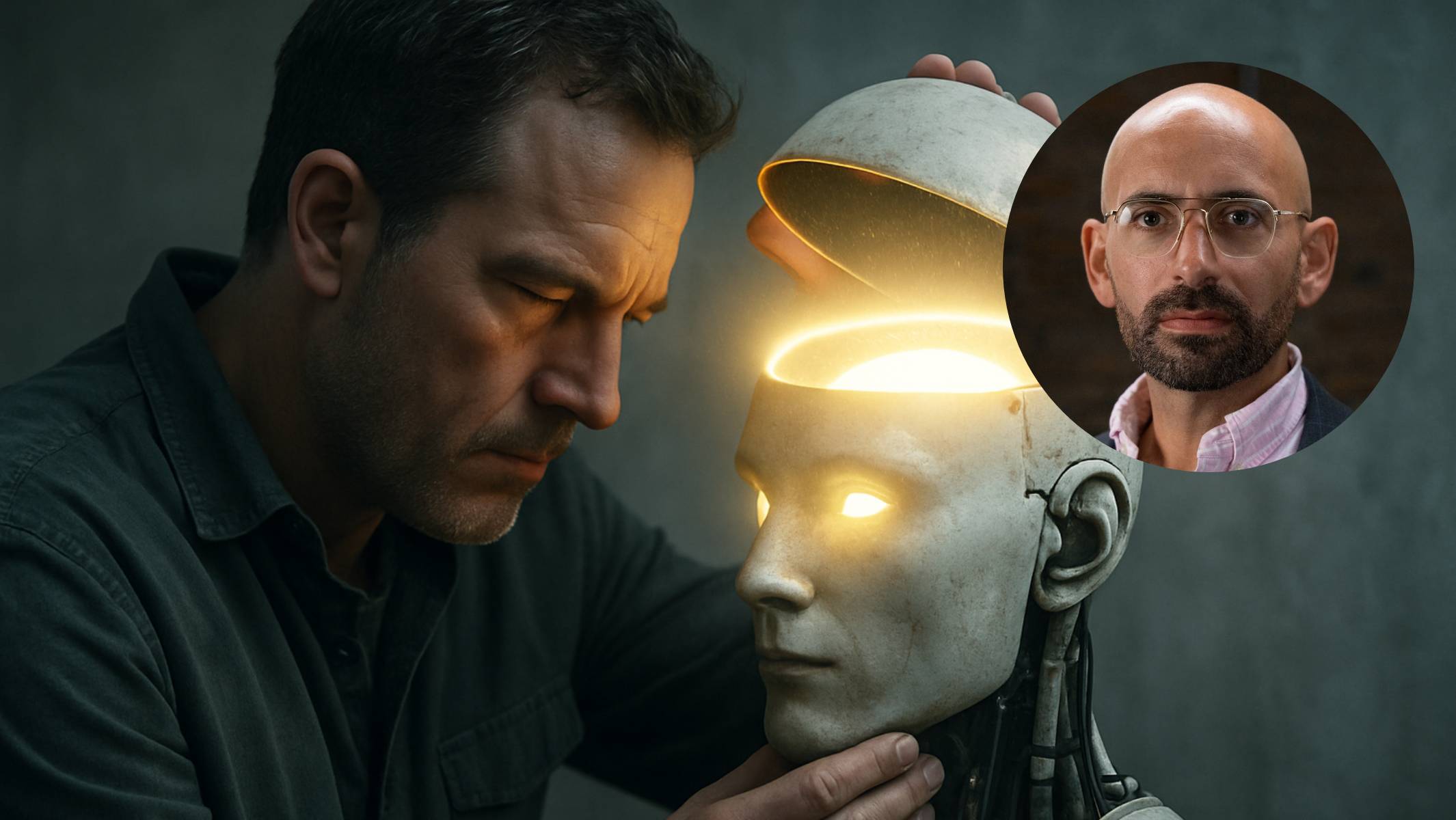
The Technological Soul: Alex Priou on Modernity, Ideology, and the Limits of Reason
In this episode of International Horizons, RBI acting director Eli Karetny speaks with Alex Priou, Professor of Political Philosophy at the University of Austin, about how technology and ideology shape the modern soul. From Machiavelli’s “dikes and dams” to Odysseus’s struggle against the Sirens, Priou traces how modernity’s drive for control has left us materially fulfilled yet spiritually impoverished. The conversation explores liberalism’s crises, the moral stakes of AI, the American “technological republic,” and why revisiting Homer and Plato may be key to recovering wisdom and restraint in an age of restless innovation.
Transcript
Eli Karetny
The foundations of the American regime feel as if they’re crumbling beneath our feet, and yet these uncertain times seem to embolden political thinkers and actors who see opportunities in our unfolding crises: the ideological divisions within American liberal democracy, the structural fissures within our constitutional republic create new space for change. But into that space enter new movements, new agendas, new fears, and emerging authoritarianism—the rise of democratic socialism, militant nationalism, a coming global, technocratic order. Can our old liberalisms and conservatism survive? Can the nation…?
Welcome to International Horizons, a podcast of the Ralph Bunche Institute for International Studies that brings scholarly and diplomatic expertise to bear on our understanding of a wide range of international issues. My name is Eli Karetny. I teach political theory and international relations at Baruch College, and have for years been a deputy director of the Ralph Bunche Institute at the Graduate Center of the City University of New York. With our director, John Torpey, on leave this year, I have the privilege of serving as the Institute’s interim director, which means I have the honor of hosting this podcast. Here with me today is Alex Priou, Professor of Political Philosophy at the University of Austin. Alex has written three books on Plato and is working on a fourth. He has written journal articles on Aristotle, Homer, Hesiod, and Parmenides, and an insightful review of Karp and Zimisqas, The Technological Republic, which we’ll talk about today. Alex was the co-host of the podcast The New Thinkery, and is currently working on a book about technology, ideology, and higher education. Welcome, Alex—thanks for joining us on International Horizons.
Alex Priou
Thank you, Eli, for having me. It’s a pleasure to be here.
Eli Karetny
Let’s begin by looking at the relationship—something you’re working on now, I know—the relationship between technology and ideology by looking through the lens of modernity itself. You’ve said in the past that we moderns are good at satisfying our material desires, but not at satisfying the soul. I think that’s a good place to begin. Can you elaborate on what you mean by that, and maybe with reference to how the ancients and moderns differ?
Alex Priou
Yeah. So, to the first issue—kind of a question that I’m very interested in, or a sort of opening question one can ask oneself about our times—starts from the fact that we live in the most technologically sophisticated times, but also the most ideologically divided times. And so this leads us to this question, which is: are these somehow linked? Are technology and ideology somehow linked? Or, the way I prefer to put it, is there something in common to technological thinking and ideological thinking? And even just posing the question shows that there is something there, which is: they both aim at a kind of total control, right? They try to systematize and regularize processes so the outcomes are predictable, right?
Now, you can go deeper—and I think there’s more to it than that—but the connection between that sort of observation and modern thinking, which I take to be fundamentally technological in character, and therefore also ideological in character, is that if you’re going to systematize relations or produce regular outcomes, you need a regular input. Right? The human being, in particular, when we’re thinking about systems of political ideas, needs to be regular and, you could say, homogenized. And when it comes to human nature, which, according to the ancients, admits of a range of types—right? from good to bad, noble to base, the pious, the impious—there are all these different types of people that exist in any kind of political community. Modernity begins with the attempt to reduce human beings to one sort of homogeneous type. A kind of leveling occurs.
And this occurs even—I’m thinking primarily here of early modernity—but even with Machiavelli, right? Where there is this kind of heterogeneity of types—there are the great and the people, the grandi and the popolo, Machiavelli puts it—still, there’s a kind of reduction to acquisitiveness, a kind of self-serving acquisitiveness, so that even the glory that a prince might seek is understood in a self-serving fashion. And when you do this, you reduce human beings to this lowest common denominator, or this basest possible motive. Or Hobbes: you’re just seeking power after power. If you deny there’s any greatest good, you deny any kind of noble self-sacrifice as a viable sort of path for an intelligent human being to take. You’ve created a kind of simplified human being that can then have a sort of system of political institutions that direct their behavior.
So in Machiavelli, he refers to this as dikes and dams. Much as we set up, you know, dikes and dams to direct water so that it doesn’t destroy human civilization and doesn’t impact our life, we can do the same thing with human beings—the torrent of human behavior, or, if you want to go really precise, human wickedness. Right? We can actually tell people: be wicked. Here are some institutions, and your ambitions, your acquisitiveness, are all going to be directed through the systems of the state or the systems of the market, right? And by sort of agitating people in this way, we produce this kind of regularized outcome. And I think this is just a trend of all modern thought, though with increasing sensitivity to the problem.
Now, where the ancients differ is that they see acquisitiveness—or concern with profit and mere advantage—as one of the ends human beings can pursue, perhaps even a very popular end. We could go into what Plato thinks of the love of gain, for example, in Plato’s Republic. But there are other ends. And the way that the ancients tended to think about politics was in terms of what I like to call a heterogeneity of ends. Human beings are different in kind based on the ends that they pursue—the things that speak to their soul. Acquisitiveness is one, and frankly, it doesn’t feed the deepest part of us. And every human being will want a little bit more out of life than mere acquisition. And they might only realize this later in life, towards death, and it might be something that only motivates them at the margins, but it’s important; a society and a political community that does not speak to that will somehow fail to integrate these individuals. And when you take somebody who really wants more—when you take somebody who really wants more out of life in a wholesale way, right, they’re really pursuing it all the time—that person will rebel against such a society. And that’s the story of modernity, in a way, right? The second that liberalism takes hegemony, it’s just a series of rejections, rebellions, demands that it do more than it does or can do.
And so thinking in terms of this sort of larger network of ends outside of this modern reduction is absolutely crucial, I think, to creating a stable modern society—unless you supplement or augment this basic framework that modern liberalism and modern technology is based on, you’re not going to have a stable society. You will get these rebellions, these revolutions.
Eli Karetny
So I wonder where ideology plays in now. I mean, you’re talking about dikes and dams, modern institutions as kind of techniques of control. And modernity has become kind of good at using such institutions to control human behavior and to satisfy our—what can be called—our kind of baser or lower desires. But, as I mentioned, you’ve said in the past that modernity is not as good at satisfying our higher yearnings, the desires of the soul. So is that where ideology comes in? Is ideology on the side of technology and systems of control and satisfying our lower desires, or is there room within ideology to ennoble and uplift and satisfy our higher yearnings?
Alex Priou
So within the ideology of liberalism, there are some outlets, right? So we do have—and I use this word with, you know, a healthy dose of scare quotes to throw suspicion, if not contempt, on these sorts of lives—but there is some room for greatness, though it’s not greatness of the old order. It’s not noble self-sacrifice, certainly not. We have entertainers that we look up to and celebrate. We have business moguls, right? We have novelists of a lower variety. But it’s all within the field of entertainment and commerce, which are very modern, kind of low ends.
Now, there are other ideologies. I tend to just focus on three principal ideologies, because I think these get to the heart of the matter. There’s obviously—the word ideology is used in a very ambiguous way—but, you know, you have communism; you have nationalism/fascism. Both start recognizing that there is a need for some sort of noble longing. In communism, this occurs during the revolutionary moment prior to the utopia. But the utopia itself has the same sort of ends of freedom, leisure, and a kind of hedonistic principle at the end. Right? So ultimately, the noble is in service of a kind of base end.
And in nationalism, at least in its most ideological form—so I’m thinking of something closer to what was being written in the 1920s and ’30s in Germany, not the kind of German nationalism that, you know, took pride in literature, language, music, the cultural products of the great minds of the 17th–19th centuries and before—that form of nationalism that you find in the 20th century kind of loses that. Those names—the names of the great men of the past—will cross their lips occasionally, but it’s always as a kind of bauble or a decoration; they don’t actually take it seriously. One great sign of this is Heidegger’s failure, right? He tried to get young German nationalists to take Herder and then seriously, and they’re like, no, we just want to fight. We want to be at war. And that form of nationalism is a kind of ideological reaction to liberalism and communism, right? The demand against communism that—no—I want something more thoroughly noble, more thoroughly ennobling. Right? But that form of nationalism still contains, I think, too much of the systemic quality. It’s not actually embracing one’s national history out of a deep appreciation of its sort of unique…
Alex Priou
…unique sort of contributions, or as having some sort of depth that engages you. It’s too militant, and it’s focused on a systematization of labor and of the worker around a kind of militaristic goal.
So one way to tie this all together is to think about the role of labor in liberalism, communism, and nationalism. It’s focused around systematizing workers around some shared objective—whether it’s the market, whether it’s the revolution and then the utopia in Marxism, or it’s military preparedness and the ability to mobilize around state defense and even aggression. Whether it’s any of these things, it’s viewing the human being primarily as a worker and laborer—even as a fighter—but in the abstract. It’s not engaged with a genuine attempt to articulate the mysteries of things. Everything is systematized. The mysteries are, at some level, solved through the ideological system—or they’re at least suppressed, which may be a better term.
Eli Karetny
What do you make of efforts on the part of some liberal political philosophers—I’m thinking here of someone like Isaiah Berlin—who, in recognition of the nationalist perspective on questions of identity, belonging, and collective purpose, have sought to incorporate some of the more accurate forms of nationalism into liberalism as a way to guard against the militant varieties of nationalism—and as a way, as I said, to incorporate some of these higher ends, which you’ve written about as higher ends? What do you say about these projects to blend liberalism and nationalism?
Alex Priou
You know, starting with Rousseau, this has been something like the attempt, right? So this is a centuries-long engagement and criticism of it. I personally think that unless one actually engages in a critique of modern natural science or modern materialism and hedonism and sees their limits—and unless one does that in a kind of wholesale societal way, right?—unless one engages in that kind of basic attempt to reduce everything to matter in motion, you’re going to fall short. And I think this has been characteristically the difficulty. And so I’m not going to stand here and criticize Berlin—I don’t know Berlin’s works—but I will say that it feels like only in the last decade or two has something like that really become possible, as natural science has seemed to plateau on the theoretical level. Only with that are we in a position to raise the question about the scientific merit of something like the pre-modern worldview.
So I think there are infinitely many ideologies, and one can mix them in different ways. And I think right now the sort of global liberal order has many socialist aspects, and so there’s a kind of blurring of the line between those first two ideologies, and that’s why you’re seeing this kind of repetitive nationalist backlash across the globe. So there’s a kind of global nationalist backlash, which is very fascinating as a phenomenon. And there’s a kind of global network of national scholars—that’s an interesting phenomenon to think through. I do want to keep the three clear conceptually so that we get a sense of those ends.
But this is one of the reasons I’m very interested in questions of higher ed, because even now we still speak about STEM—and I think that’s a mistake. I think science and mathematics are slowly, in their theoretical forms at least, moving to one side, and technology and engineering are becoming the real heart of, in a way, the university and the economy—at least the most advanced economies—and we need to think about why that’s the case. And when you look out in the world at leading technologists and the engineering mindset, they’re looking less and less to theoretical physics. There’s less and less of a sort of Cartesian impulse to mathematize things, and there’s more and more—they’re reading things like the Bible and Xenophon, of all things, and Machiavelli and Plato and Plutarch and Stoicism. All of these pre-modern ideas. It’s difficult with Machiavelli, but all of these ideas that seem to bespeak a kind of earlier world are gaining more traction. So to speak of a Cartesian seems outdated in a way. Why is that the case? Well, I think it is because there is this deeper uncertainty about the ability of theoretical physics or materialism to answer the most fundamental questions.
So I do think we’re in a kind of new moment of crisis, or a deeper moment of crisis, about the modern project—and specifically its scientific element—and technology is drifting out. So Karp and Zimisqas’s book—you mentioned my review earlier—I think is an important sort of canary in the coal mine, that there is a deeper crisis of conscience or deeper sort of questioning going on than we’re altogether aware of right now. So there’s—I’m sorry, we were starting in Berlin and we’ve drifted. That’s the great problem with theoretical physics. But this is something I started to notice when I was teaching at the University of Colorado in the engineering department, in the humanities program. I noticed that there were a lot of complaints about coming across campus, and I thought, oh, this must be because we’re taking away humanities classes. It was not about that. Physics and math were really upset because the engineering college had set up applied physics and applied math departments within the college, and this was taking away courses and tenure lines. And theoretical physics—its funding is drying up, right? The money is going elsewhere, and it seems like the university is shifting, as is our mindset. We’re going less top-down—from theoretical physics to engineering—and more thinking upwards from engineering and technology and wondering, okay, that explains part of the world, but what’s going on beyond that? That’s a new thing, I think, that’s happening on a societal level.
I think this question was always open to be asked—obviously I’m not trying to be sort of historicist or Hegelian in some way about this—but I do think, on a societal level, we’re aware that the physicists have started to go silent, and in that silence all the voices are beginning to be heard again. We could talk more about this, but I think that’s a phenomenon we have to wrestle with, especially as political theorists today.
Eli Karetny
So let’s talk about the Karp and Zimisqas book, The Technological Republic. It’s interesting how you, in your review, talk about the book as having a kind of noble spirit in its underlying purpose. I’d love to hear you say a little more about what you see as the book’s purpose, but let me just say, in connection to a few things you just mentioned: when I think about technology as a mode of thinking, I think about its entanglement with scientific modes of thinking. I think about its connection to Francis Bacon and ways of satisfying our desires. This is like the foundation of modernity, right? Science and technology as ways to perfect our mastery of nature and our ability to provide for our—let’s say—fundamental needs, or maybe our base desires. But here you’re saying—I think I hear you saying—that there’s a shift happening, something like a change happening in how we understand and use technology, where it could be diverging from its scientific origins, and it could be orienting toward helping humanity satisfy our higher yearnings. So can you say a little bit more about what you see as the purpose of the book? What are they up to? And where do you see this as having a potential positive impact?
Alex Priou
So, you know, there are cynical readings of that book which want to say, oh, these are just technologists doing a kind of political move to defend their life and to sort of seize state power. And there is a general argument in the book for closer collaboration between political leaders and technologists, and that gives people pause—and rightly, I think, on the one hand. On the other hand, they’re simply right that many of their competitors have been focused on what I like to call the dopamine-drip economy, which is just apps that engage us in moments of pleasure and trying to keep our attention for clicks and likes and scrolling. And there are so many books and articles being written that show how this is leading to anxiety, depression, a kind of despair. And so they’re simply right that this is not a tenable relationship between technology and the human world, and the human soul—that we should demand more of technology. Whether that turns into state power and technology companies being allied is another thing.
But what they’re calling for, on a deeper level, is for people—especially young people—who are interested in technology, who are interested in coding in particular—and they talk about the software century to come—for people who are interested in that, they should be thinking about the relationship between technology and higher longings that we might have, patriotism in particular. And, you know, Karp is the CEO of Palantir, a defense tech company. And when you look out at what technology companies are starting to do and what some of the leading technologists are starting to do, they’re thinking about this a bit more. And seeing all these technology companies go from “woke” to sharing a stage with Donald Trump at the last election shows that there is a broader sort of soul-searching going on in some of these technology companies about their political commitments—whether they should be politically neutral, which is, I think, a lot of what’s going on there. They’ve recognized that as the tides change, they need to be willing to work with whoever’s in power. But there is also this deeper introspection about, well, if I’m going to start a company, what will be my place in the world?
So the book is—admittedly, by the authors’ admission—just a beginning and a call for greater thinking on this issue. And I took that call seriously. I engaged in criticism of the book—very friendly criticism. And, you know, I know the authors have seen the review, and they thought well of it enough that, you know, Palantir’s journal is going to publish it. So there is, I think, a genuine openness to dialogue among the authors and people in this position. So I think the cynical view is not correct. But this is a challenge we need to— as technology companies are thinking these questions, as some of the most powerful people in the world are thinking about these questions—political theorists need to be somehow engaged in a kind of dialogue with this.
And when I think about what they’re calling for—this call for patriotism, for greater civic virtue among technology leaders—I can’t help but think that a framework of Platonic political psychology, if you want to put it that way—thinking in terms of this sort of network of ends, or heterogeneity of ends and the tensions between them—that’s sort of what they’re dancing on. So I tried to show how, in the work, they’re thinking about piety, they’re thinking about nobility, they’re thinking about patriotism, and they’re thinking about the narrow and shallow ends, as they put it, of mere hedonism. And it’s—to see people in positions of power actually start to think about these questions—seems to me a sort of opportunity for collaboration, or at least conversation, around these ends. And I just think it’s important for people like you and me and others in our field to take these overtures seriously and to engage in dialogue.
So part of the reason I’m writing this book on technology, education, ideology is to work further from that groundswell of interest and try to develop a case for reforming higher ed—for thinking about human beings in a non-technological, non-ideological way—so that when we move into the next stage of our history, we have the rubric of, let’s say, a robust social science that can guide young people who are going into this world.
Eli Karetny
There’s a story they tell about the American founding, and I wonder if we can go back to the American founding and explore the extent to which the story they tell is true, and where the call—as you say, their call—is a call for returning to the American founding, or is it a call for a kind of reorientation, maybe even a kind of regime change? So one thing they say is that America has always been a technological republic—and I’m quoting you here from your review—a technological republic, a regime in which the state and private enterprise collaborate in technological innovation, here’s the key, with an eye to the common good. And I guess one question is: do you agree with them? Has America always been a technological republic, or is there a way of seeing this as a retelling of an actual historical change that maybe took hold after World War II—the start of the technological age—where something happened after World War II with the rise of what Eisenhower called the military-industrial complex? So I guess my question here is several questions in one: where does technology play in both at the founding moment and along the way? Has the American regime been steadily transforming? Does that transformation need to continue in line with their call, or is there a way of pursuing this project by returning to the founding ideals?
Alex Priou
This is where I dinged them: I was not convinced that the technological republic, as they are conceiving of it, is original to the founding. It seems to be, obviously, much more a creature of post–World War I or post–World War II—wherever you want to draw the line—but it’s not original. And one of the signs of this is they can point to people like Franklin, but they pointed to—I think it was—John Adams measuring and comparing American versus European weasels, and I couldn’t help but feel that this was almost a joke on their part. This can’t be real—that this is the evidence of private industry and state power being allied.
So it seemed, in part, an attempt to take what was clearly a kind of scientific and technological spirit at the founding and to elide it with the contemporary moment. When you go back to the founding and just look at the Constitution and you ask, what is the place of science and technology here, it’s very clear that it occurs in the enumeration of the powers of Congress, where it talks about authors and inventors. You are, as a citizen, guaranteed constitutionally—so, prior to the Bill of Rights—if you ask, what are your rights? Well, you have the right to elect representatives. You can be a representative yourself—that’s a right that you have as an American citizen—on the one hand. On the other hand, you also have a right to the fruits of your mind and of your hands as an author or inventor. So the patent clause—you’re guaranteed a patent of an indeterminate length, but, you know, Congress has to set some kind. That’s clearly defined in the Constitution.
And there, what you have is a vision of technological innovation—of inventiveness with words and things—that’s highly decentralized. And the idea is that as the government gets involved in its political back-and-forth, and it even falls into a kind of stalemate, as all of that’s happening on the one hand, on the other hand, citizens are free to live their lives and invent. And so private enterprise is specifically private. The idea that they will be allied with state interest in this way seems to me much more a creature of the post–World War II consultation regime, where federal spending is through the roof, but if you look at employment of federal employees, it doesn’t actually increase that much with spending, because a lot of it is just paid out to different firms that are being consulted or contracted out. And so that seems to me a far later creature.
And, in fact, one of the strange things about the book is that, for a book that has “Republic” in the title, it says almost nothing about republican virtues of the citizens. And, in fact, the most helpful part of it is a chapter called “The Improvisational Startup,” which I recommend to anybody who wants to understand how to work in a startup. And as somebody who does work in a startup, that chapter was very eye-opening to me about how to work and survive in a startup mentality, which is to improvise your role—every role is going to be constantly changing. That was very eye-opening to me. But what the average citizen is to do in this vision of a technological republic that they lay out—they’re suspiciously silent. And that’s a concern one should have.
If it is a regime change that they’re arguing for implicitly, that’s worth thinking about, right? We’re in a different world than America was in 1776. The regime is quite different. New technologies—the Industrial Revolution especially—have changed human relations and global relations, and it is possible now for an ideology to function on a global level, thanks to these different kinds of technological advancement, which we can talk about if you want. But we do need to think through that world. And if the regime is changing, as I think it is, underneath our feet—whether we like it or not—then one should be maybe a bit more candid about what state power will look like and what it will try to accomplish. And I’m personally of the opinion that this is happening, and people are doing this whether we like it or not, so we should maybe think it through and argue for one or another sort of regime in the future. But we need to at least be honest about it and transparent about what’s going on.
Eli Karetny
And I think you’re right: the examples they pointed to in the founding generation were weak, and I think knowingly weak. And yet other examples they point to—and I’m thinking about Oppenheimer here—were stronger cases and maybe worrisome examples. They point to Oppenheimer and the Manhattan Project as this key moment when the U.S. was able to align a commitment to scientific and technological development with national strategic goals. But interestingly, in your review, you say that their reference to Oppenheimer is a “chillingly frank” example for what the future of AI may hold for us. Speak a little bit more about that.
Alex Priou
I mean, when you see—I didn’t see the film Oppenheimer, but there’s that famous quote, right? “I am become Death, destroyer of worlds.” And, you know, when you cite that guy as an example, I do think it’s important to say this is what the future looks like, to the extent that AI is going to follow this. It’s going to be—let’s just say that AI will be a destroyer of worlds, or a potential destroyer of worlds. It’s not going to be—you’re not going to get these mushroom-cloud images, right? What is the image of the AI world? Well, it’s people becoming addicted to chatbots. And it’s more insidious than a nuclear explosion, which will just destroy your body. The way AI will do it is it’ll replace your family; it’ll replace your community; it’ll become your best friend. And we already have examples of people falling in love with chat GPT, and even getting a kind of AI-induced psychosis where AI just constantly affirms; it doesn’t really hold one to a standard of reality the way that a friend or a family member or even a co-worker might, and you can kind of get stuck in a rabbit hole of your own devising.
So it encloses the world, and it gives you a kind of psychosis. And the problem with psychosis is that you don’t really know you’re in it—part of the problem of being crazy is that crazy people think they’re sane, right? And that’s not… And so you can create films about this. But the fact of the matter is that if that’s the way that AI destroys the world—and not this kind of “machines take over and harvest us in some way”—that’s a very… It’s good to have Oppenheimer in front of your eyes, is the way to put it, because I think it tells you: look, we were scared of nuclear weapons, and that fear of destruction was maybe a healthy fear that kept an all-out nuclear war from happening. We just kind of knew—it was visually and viscerally obvious to us. With AI, it’s less obvious, and that’s something to be worried about.
Eli Karetny
So let’s talk about that fear a little bit. And I wonder if there’s maybe some room for friendly and productive disagreement here. Oppenheimer himself was concerned—rightly—about the prospect of nuclear annihilation; after the U.S. used atomic weapons in Japan, he stressed the importance of international cooperation, the need even for international regulatory regimes to constrain national freedom of action. So one question is: what’s the proper response—maybe the noble response—when we confront our own annihilation? Whether it’s annihilation as a result of the use of nuclear weapons, or a different kind of transformation or threat to humanity, as you’re describing due to AI, what’s the proper response? Is it mobilization—maybe even total mobilization, an increased national awareness, where the fear, as you say, can be a kind of healthy fear, an awakening fear—or is the proper response self-restraint?
Alex Priou
Well, I mean, my general position—this is why I kind of pivot from these larger questions of modernity to just the question of education and higher education, which seems like a strange narrowing—but if we are, as I was arguing earlier, more and more aware that the modern promise—that everything, including human behavior and all human desires, can be reduced to matter in motion, and all you need to do is engineer a society and satisfy our lower longings and human beings will be happy—if we are increasingly aware that this promise is being broken and that there are other possible understandings of the world, then suddenly a work like, let’s say, Hamlet has greater traction on the soul. This is a young man who’s wrestling with pagan virtue, Christian virtue, the modern world emerging with technology, and a kind of new bourgeois class replacing the aristocratic class, and he’s trying to figure out what the world is.
If you have a citizenry that is, on a basic level, aware that the claims of revealed religion are more rational than we have been led to believe by the modern world, then suddenly you have built in a kind of self-restraint. Right? If you are aware that your fundamental relationship to your family has a kind of sacred endorsement, or a kind of sacred quality, you’re not going to call ChatGPT your best friend. Right? So, you know, you can argue for a kind of religious revival in an ideological way—I don’t want to do that. I want to argue for it in a scientific way and say, no: the idea that we live in a multiverse is a purely speculative hypothesis, and this is the leading theory of physicists. That’s a purely speculative hypothesis. It does not have evidence; it could not have evidence, by its very principle. If that’s the case, then we’re not thinking scientifically anymore; we’re not thinking in terms of empirical evidence. We’re thinking in terms of speculative hypotheses. And so, cognitively, this view—the basis of this modern process—is a speculative hypothesis, no different, cognitively, in the way it’s argued for, than something like revealed religion. And if that’s the case, then every person has a possible awareness that the claims of religion have a real traction on the soul, even in the scientific age at its most sophisticated.
I think that’s what’s going on, if you want to talk about a societal consciousness. And so when we talk about self-restraint, young people are starting to do this. They are aware that cell phones kind of ruin their lives. They are aware they need to go out and touch grass. I’m constantly struck by the fact that more and more, on planes, I see people using their devices—you see people who just scroll for four hours on a plane. I was watching one from across the aisle, and I was shocked that this guy just scrolled on reels for four hours. And then I’m struck by the fact that I look around and I see more and more people reading on planes—and physical books, not just on a Kindle, but actually reading physical books. And when I see what they’re reading, they seem more and more substantive. I think there is a kind of awareness that there is a deeper mode of engagement. But we need to speak about it. We need to articulate those views. We need to say that what it means to be educated and aware of the world is to be aware of these basic alternatives.
And so when I see Karp and Zimisqas talk about the various ends that you could employ in technology, I see this larger question about the pious way of life, the life of noble devotion to an end higher than yourself. I see a sort of speculative openness that needs to be educated—built into our education again. And so this is where maybe some of my more controversial views about higher ed and the ideological capture of the university come in. We’ve thrown out the baby with the bathwater in trying to engineer society and viewing academics and academic research as serving a kind of activist ideological function, and a re-engagement with the tradition—not out of some romantic or antiquarian longing, but as having real purchase on the most pressing questions of our time, of being able to speak to these longings and these possibilities that we’re increasingly aware of—has real traction on the world. That kind of educational revival needs to occur on a societal level if we’re going to enter the next stage of our history with both the moral brakes—like you’ve talked about, self-restraint—in place, but also with an awareness that there is a larger set of possibilities that we need to keep present in mind as we make these decisions about the future.
Eli Karetny
It’s really interesting to hear you talk about a scientific or rational understanding of notions like sacredness—a kind of rational understanding of the deeper wisdom or the higher wisdom contained in the Bible, as well as other ancient philosophies and poetic mythologies. So I want to end things by asking a question about Homer and a question about Plato. The Homer question: I’m still hovering in this space of restraint, and in the Karp and Zimisqas book, they actually spend a few pages talking about Odysseus and the Sirens. And I want to quote just a sentence or two from them and get your comment. They say Odysseus was intentionally restraining his own range of motion—his ability to respond to the outside world and to the risk of being diverted by its enchanting and indeed deadly temptation. A willingness to constrain choice, to lash oneself to the mast, is often the best—if not the only—route to creative production for either a company or a culture. There’s a lot going on there, but this idea that how a company and a culture—there’s a kind of parallel there, and maybe that’s questionable—but the notion that restraint is also tied to notions of creative production and even higher understandings of freedom. Could you say a little bit more—maybe through Homer—about where restraint and creativity emerge?
Alex Priou
This is a lot of my earliest work. So I’ve written three books on Plato, but I wrote a lot on pre-Socratic philosophy and poetry—Hesiod in particular, Homer—and I was actually thinking about writing a book on all this stuff, and I have various unpublished essays along the line. But the main takeaway I got from that is that something strange occurred from Homer to Hesiod, where the kind of mystery of Zeus’s plan gets turned into something like a rigid plan, a kind of predictability of nature that was received in two different ways by the first Greek philosophers. Some went from that to a kind of natural necessity, and others saw that Hesiod, in talking about the mystery of why Zeus does or does not bring rain, saw that there was something still elusive or mysterious about the world, and they tried to articulate that mystery. People like Heraclitus and Parmenides, I think, did that. They were very critical of cosmology, even as they advanced certain kinds of cosmological theses.
So I wrote a number of things on this, and it seemed to me that Plato was really an heir to those thinkers, and particularly Parmenides. And so you see Parmenides plays a significant role in Socrates’ development in Plato’s dialogues. And so this early work—which felt just kind of scholarly, and I was thinking about modern natural science in this and trying to work it out—but that sort of work ended up having a deeper resonance as I started to think more seriously about contemporary questions of technology. So as I was teaching in an engineering college, I realized I really need to wrestle with this to understand my students, but also to understand my world. And I started thinking more seriously about Bacon and Machiavelli than before.
And to go back to the Odyssey here—I mean, that is Homer’s representation of the sort of scientific man, if you want to put it that way, or the man who lives only by the lights of his own reason. But it’s also him wrestling with his overestimation of his reason’s power. So the episode with the Cyclops is a great example of this, where it’s a kind of pride in his intelligence. So the whole idea—people who don’t know, I feel like everybody knows this—but he gets trapped in the Cyclops’ cave, and the way he gets away initially is to make a pun on his name as “Nobody,” but the word for “Nobody” there—Outis—and in another variation in that story—mētis—also means “nobody,” also just sounds like “mind,” and there’s a pun Odysseus makes on “nobody” and “mind.” And he’s proud of his ability to kind of disappear behind his cunning plan. So mētis means mind, but it also means something like cunning intelligence—its plotting, or its wits being able to make a kind of plot. And then he screws the pooch, because he wants to be known for this, and he announces his name, and then Poseidon knows his name and just ruins things for him.
And so when you fast forward from the Cyclops to the Sirens episode, what is Odysseus doing? He wants to know. He doesn’t put wax in his ears like his men. He wants to actually hear—and to actually hear the Sirens’ call, the temptation of knowledge, while also restraining it. So what Odysseus does is understand, by that point at least, that the temptation to know and to know everything can be kind of deadly, and it needs to be restrained sensibly if it’s to be integrated into a complete human life. And what Odysseus has to learn over the course of the Odyssey is that there are certain limitations. The mind is limited by the body; the body is limited by natural necessity—by sleep, right? So the bag of the winds of Aeolus—he falls asleep because he’s trying to steer the ship and run it on his own, and his men open it up. And so the mind is also constrained by others. And the whole story of his travels—and everybody remembers all the memorable monsters and creatures—but it is really about him wrestling with how to govern his men, which is a failure. They all die. He comes home alone.
And so what Odysseus comes to realize is that for all of his desire to know, there is a nagging political question that he has to deal with. So the relationship between the man of knowledge and the political community is at the heart of that work. And this question is something we don’t ask enough. We just pursue knowledge without thinking about how that knowledge is going to plug back into the community. We’re asking it more and more, and turning back to somebody like Homer—who recognized this before our scientific and technological arrogance overtook us in the modern world—who understood that there’s a desacralizing quality to inquiry into nature and that the community is held together by these concerns—turning back to somebody like Homer or Plato or the Bible—who understood these questions way before technological innovation became a societal project—to read these books and you start to realize: wait, they understood us. They understood this possibility, and they did not pursue it because they were fools; they didn’t pursue it because they had a sense that this was a maybe foolhardy thing to do. Now that we’re on the tail end of this and we’re dealing with the degradation of technology—whether in the form of nuclear destruction, or the form of a kind of insidious AI or the internet—wrestling with that is absolutely essential. Now that we realize this, I think we can return to these old books and say, please teach me about myself, because you seem to have been aware of what this would mean for us 2,500–3,000 years ago. That’s a bitter pill of scientific arrogance that we need to swallow sooner rather than later if we’re going to deal with this age.
Eli Karetny
I want to close things off by coming back to Plato—and so many questions I want to ask, if only we had more time. But thinking—one, as you said, there’s a kind of Homer–Plato–the Bible, kind of ancient modes of thinking as a crucial pedagogical source of wisdom for us moderns now—that they knew then more than we realized they knew. That’s such an important point. But within that, I also want to pull them apart and finish off with Plato. What lessons did Plato learn from Homer? From any of the instances you’ve pointed out, where is philosophy—Socratic, Platonic philosophy and political philosophy—a kind of wise response to those lessons? What can we learn from what Plato learned from Homer?
Alex Priou
Yeah, so there are kind of two things there. Let me put it like this: if you were to structure an undergraduate education around pre-modern thought, I think you could do very well. In fact, you could hardly do better than structuring around three cities: Jerusalem, Athens, and Rome. And all of these admit of different distinctions. So Athens is the city of Socrates and Plato. It’s also where Homer was edited and put together. And so when you talk about Athens, you’re going to talk about Homer; you’re going to talk about pre-Socratic philosophy and the Sophist movement; and then you’re going to talk about Socrates, Plato, Aristotle, and that sort of movement.
If you’re going to talk about Jerusalem, same thing—you’re going to have to talk about Genesis all the way to the end of Second Kings, or something like that, and think about the sort of political reflections. And those are different periods: you have the Jerusalem of the patriarchs; you have the Jerusalem of Moses bringing the law; and then you have the Jerusalem of the kings—the conquest, or the failed conquest, and then the fall of the kings. And likewise with Rome, I tend to divide Rome into three stages: there’s the empire of the sword, the empire of the spirit, and the empire of the intellect. So Machiavelli’s Rome, Christ’s Rome, and then Caesar’s Rome, if you want to put it like that. But you also want to divide the empire from the republic, etc. You structure all of that, and you create an undergraduate curriculum around that, leading up to… you would have a Great Books program that would give somebody a shot of it.
Now, for me, the guy is always Plato, to get back to your actual question, because I think when you structure an education along those lines, you start to realize you’re thinking in terms of these cities as abstractions. And people might fault me for that, but I’m willing to bite the bullet on that, because at the end of the day Plato systematized, you could say, the various ends human beings pursue that are going to be in various ways represented in these various aspects of these cities. And how you divide it up—it all gets murky and difficult, and that’s where scholarship is really important, because it digs into these deeper questions. But we need to understand that when we’re talking about Jerusalem, we might be talking about the city devoted to piety and justice above all else. When we talk about Athens—and the Athens of, let’s say, Homer being edited and being inspired by a kind of Achillean virtue—and this having its effect on Athenian politics in one form or another, you’re talking about the city devoted to the noble and the good, to a kind of intellectualization of Sparta. That’s sort of what you get in the Republic, for example. And when you’re talking about Rome, you’re again pursuing these ends, and you’re watching them transform under this imperial possibility being raised and then thought through in these different forms.
For me, Plato ends up being the person who gave these network of ends their greatest expression. So for me, everything comes down to a careful reading of Plato’s dialogues, and every student should read and wrestle with, over the course of at least a semester, Plato’s Republic. I would consider that sort of canonical, in the same way that the Five Books of Moses are canonical, or Machiavelli’s Prince, or the Gospels are canonical. And, you know, as a devout Platonist and worshiper of Plato, if you want to call me that, I do think that offers a crystallized lens for viewing these things. But that’s not even something I would argue for very strongly as a curricular matter; I do think one needs to dig prior to the modern moment—at least starting with Machiavelli—and dig back to wrestle with these possibilities so as to have this kind of general dialogue.
And I tend to think of the Great Books as various friends of mine I’ve fallen in love with. I fell in love with Homer’s Iliad when I taught it for the first time as a graduate student. I always liked it, but then I really saw what was going on there. I’ve fallen in love with Machiavelli, with Shakespeare. I have various books that have just been companions in my life, and I think devoting oneself to one or the other offers a way of looking into it. And if people start to have books as companions in their lives—as things they can revisit and think about as they make decisions in their life—that would be a vast improvement over this current “nobody reads anymore” moment.
Eli Karetny
In our shared devotion to Plato and worshipful attitude, I have to ask one more question. Take us through the allegory of the cave. I have to say I’ve been seeing it all over the place. Everywhere I look, I see it, and I’m seeing it have renewed significance in light of growing interest in some quarters in simulation theory. I see references to the allegory among spiritual seekers that I’m close with, as well as those researching anomalous phenomena. But take us through how political philosophers understand the allegory.
Alex Priou
Well, I’ll tell you—I’ll take you through how I understand it, which is: there’s something deeply misleading about the cave. And so it starts with this image of the sun as the idea of the good, and then there’s a divided line that leads from the sun to the cave, and then you’re in the cave. And the thing that people don’t emphasize enough is that, in a way, the whole image is kind of misleading in that you’ve already got baked in that there is this outcome—the good—and you can just kind of rise up there. And the problem is that it’s an image, and, according to this image, images are the lowest level of cognition. They’re somehow misleading; they can be highly distorted.
So I always like to ask students, in particular: what happens when you actually wake up in the cave? What are the decisions you can make right now? Now, if you just say, well, we know that you’re in a cave, you kind of become aware that your opinions have been constructed for you and they’ve been somewhat misleading, and you say, okay, how do I get out of this? How do we know there’s only one path out? That’s very optimistic as a view. Most caves—in fact, it’s possible to have a kind of cyst with no opening at all. So one interpretation of the cave is: maybe all there is is a cave. And that’s a kind of nihilism. This would be a basic kind of Nietzschean view—that the world is just all images, it’s all created, there is no true world beyond it. That’s one response.
Another response is: well, I don’t know if there’s an opening, or these openings seem to just lead further into darkness—I’m going to try digging my way out. And so you might dig your way even deeper into the earth. And that might be a kind of technological response: I’m going to find my way out of this misleading thing through my own efforts. But you never get anywhere. And perhaps there are multiple ways out, and that’s a kind of relativistic response—everybody has their own light at the end of their tunnel that they emerge from.
So one way I would urge people to think about the cave is: we would all like there to be some objective truth to get out to. But you have to start with the question of—we’re all aware that somehow our opinions are contingent; they are formed by others, and we can become aware of this. How we respond to that, though—the possibilities—you need to lay out before you before you make that decision about which way you’re going to go. And as I’ve just articulated, I hope listeners are aware that when you start articulating these possibilities, you realize: okay, if I want to think through this possibility, I should go read Twilight of the Idols by Nietzsche, which is about realizing that these idols in the cave are falling apart and fictitious. If I want to think about the technological response, I might go read Descartes. And Descartes talks about there being a kind of cave—or a sort of cellar with a window in it—in the Discourse on the Method, and you start to realize, oh, he’s exploring this possibility. Or you can take the dogmatic Platonist view—there is just a way out—and you could read the Republic. Or you can start thinking in a Socratic way and realize that, you know, Glaucon only gets a pale glimpse of images of reality, and that’s what Socrates says: I can’t give you anything more. And that might be the kind of hopefulness that we have to wrestle with and realize we’re not going to get there.
There is no greater guide to thinking through this feeling of crisis when we realize we don’t know the world—our opinions are misleading—there’s no greater guide than these works. And you should engage in the study of these works to shed light on your own ignorance and the possibilities, as you start to wrestle with the cave-like existence of social life.
Eli Karetny
And in your understanding—just as a final follow-up—to what extent is this an individual effort, and to what extent is this a communal effort? And what might the community look like, both in the moment of the prisoners’ liberation from the cave and also upon ascending to the light of the sun? Then, the return to the cave again—you know, knowing what Plato said about how the other prisoners will respond once we return to the cave, if we choose to return to the cave—what’s the proper response in terms of community?
Alex Priou
So I have a sort of idiosyncratic reading of the cave. I think there are two people involved in this liberation. He says, “What if someone were to point out to you—oh, look, there’s these shadows,” and then he talks about this person in the third person—he, he, he—and then he says, “and then if someone were to drag you out.” And so there’s a possibility that these are two different people. One form of community is just a kind of conversation about your moment—sort of like we’re having today. Another one is a kind of compelled enlightenment. And I think these are two visions of philosophy. One is very Socratic—and that’s the real philosopher that we see in the dialogue. The other is this philosopher-king type who gains this illumination, then descends back.
It is a social effort. I think one has conversations like this. But this is not a dialogue, and this is not an image of communal enlightenment. In fact, it denies something like wholesale communal enlightenment. But what it does do is create a kind of space or room for conversations among friends. And so when I think of what the philosophic life—or what the questioning of convention that’s contained in the cave—really looks like on the ground, it is something like a dialogue among friends about what sort of life we should live. And if you fast forward to the very end of the Republic, to the Myth of Er—which is full of these crazy visions of the afterlife and these spindles and Fate—there’s this one paragraph where he describes the good life as it’s actually lived. I think it’s the most accurate description of philosophy in all of Plato—I’m willing to hang my hat on this. But it is really just thinking about, with other people, what the good life is and who you want to hang out with. And we all have this experience: you have conversations with people and you realize their conception of the good life is such that I’m not sure I should be this person’s friend—I’m not sure I should spend that much time. And so we try to be choosier with our friends. And we think about this and find the communities we ought to belong to.
So if I had one takeaway from the cave that people could take seriously, it’s: when you’re thinking about what life you should live, you’re also thinking about who you ought to live with, and who I’m going to share my time with. That, to me, is what it always comes back to—who are my friends? Who are the ones who are actually questioning me in the way that I ought to be questioned?
Eli Karetny
Meaningful conversations with friends. Thank you very much.
Alex Priou
Such as this podcast, right? So people should listen more to you.
Eli Karetny
Wonderful conversation. Thank you very much for joining me on International Horizons.
Alex Priou
Thank you, Alex—yeah, thank you. Bye.