
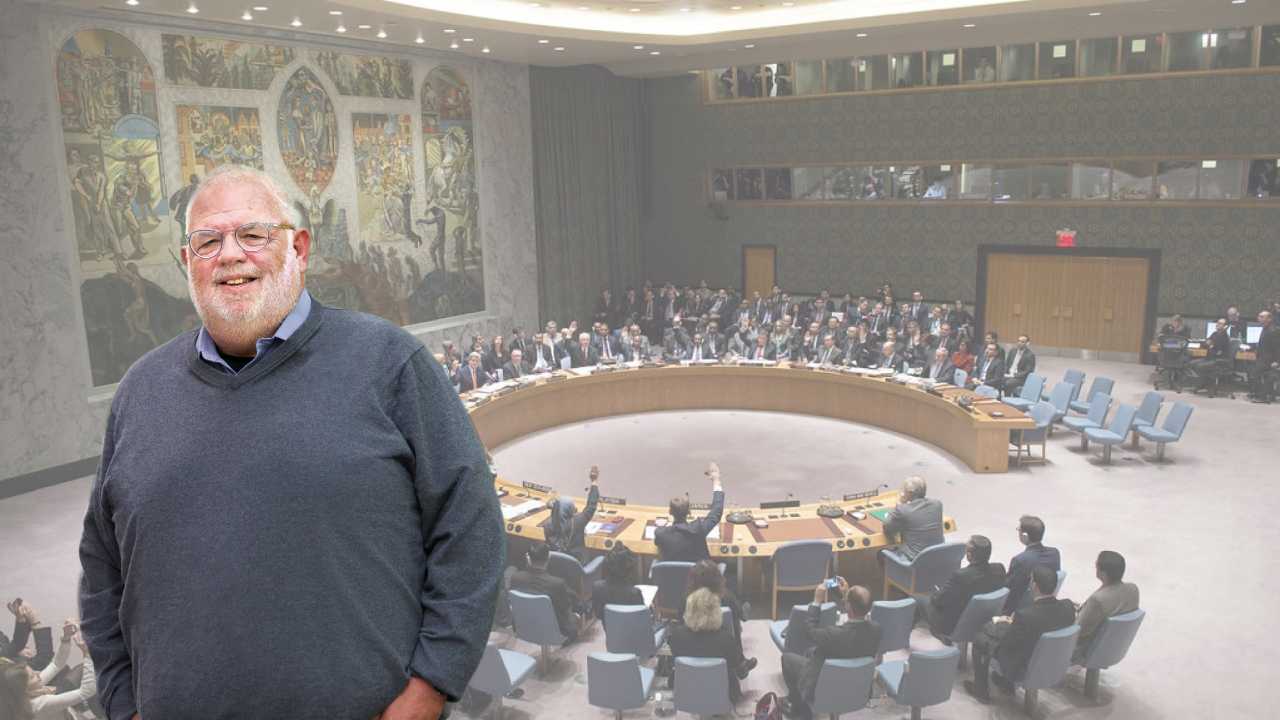
Trump, the UN Charter, and the Strange Politics of International Law
International law scholars are often among the sharpest critics of the Trump administration—but what if the usual story misses something essential? In this episode, RBI interim director Eli Karetny speaks with NYU international law professor Robert Howse about Trump’s complicated relationship with the UN Charter system, from Gaza to Venezuela and Iran. The conversation also turns to political theory: Leo Strauss’s reputation as a neoconservative godfather, the shadow of Carl Schmitt, and how today’s MAGA New Right recycles older anxieties about liberalism, virtue, and masculinity.
Transcript
Eli Karetny
Among the harshest critics of the Trump administration have been scholars and practitioners of international law who see Trump policies and actions at odds with the UN Charter and the post-war liberal international order. But some international law scholars see things a bit differently. I quote from a thought-provoking recent article:
“In a world where Israel bombs whatever country in the region it feels like on a given day, without much of an effort at justification, and where regional powers can, with effective impunity, fuel with arms and money atrocities in Sudan on an even far greater scale than Israel and Gaza, making Trump the major villain in the breakdown in international law orthodoxy seems at least half blind. The last real victory of the UN framework was, in fact, because of, not despite, Trump: a Security Council resolution entrenching a path forward on Gaza and indeed Palestine more generally got through unvetoed. How many international jurists now demonizing Trump as a destroyer of the Charter system cheered the passage of that resolution?”
Welcome to International Horizons, podcast of the Ralph Bunche Institute for International Studies that brings scholarly and diplomatic expertise to bear on our understanding of a wide range of international issues. My name is Eli Karetny. I teach political theory and international relations at Baruch College, and have for years been a deputy director of the Ralph Bunche Institute at the Graduate Center of the City University of New York—this year as the Institute’s interim director. I have the privilege of hosting this podcast.
Here with me today is Robert Howse, the author of the provocative words just cited. Robert Howse is the Lloyd C. Nelson Professor of International Law at NYU School of Law. Professor Howse has served as an advisor to government agencies and international organizations such as the OECD, the World Bank, UNCTAD, the Inter-American Development Bank, and the UN Office of the High Commissioner for Human Rights. Professor Howse serves on several editorial boards, including London Review of International Law, Transnational Legal Theory, and the Journal of World Trade and Investment. He is the author or editor of numerous books, including Leo Strauss: Man of Peace, The World Trading System and the Federal Vision, Legitimacy and Levels of Governance in the EU and the US. He is also the co-translator of Alexandre Kojève’s Outline for a Phenomenology of Right and the principal author of the interpretive commentary in that volume.
Welcome, Robert. Thanks for joining us very much on International Horizons.
Robert Howse
Thank you for being here.
Eli Karetny
We’ll get to Trump and international law in a few moments, but I want to start with your Strauss book, which offers a different perspective from his critics who interpret his political thought through the lens of neoconservatism. It wasn’t just journalists like Seymour Hersh and James Atlas who saw Strauss’s hand at work in post-9/11 US foreign policy. It was also scholars like Anne Norton, Shadia Drury, and Nicholas Xenos.
Can you talk about what the critics got wrong about Strauss, and also what the neocons, some of whom were in fact influenced by Straussian thought, continue to get wrong? What makes him, as you label him, a man of peace?
Robert Howse
So the neoconservative movement really got going as a response to the perceived softness of liberals, particularly American, but also Western European liberals and social democrats with respect to the Soviet Union. And initially, the idea was that whether it was in arms control negotiations or responding to events such as the rise of the Solidarity movement in Poland, that the West—dominated by these liberal regimes—had proven dangerously weak, willing to compromise with the Soviets and unwilling to stand up to them when they were assertive or aggressive, or engaged in what the neocons found very frightening military buildups.
And so this original aspect of neoconservatism—Irving Kristol, Norman Podhoretz, and so on—really does intersect with an aspect of Leo Strauss’s thought, which was that he was also strongly anti-communist. Certainly there was an agreement, or kind of agreement, with the neocons that it was necessary to take a hard line with the Soviets. One could not expect the Soviets to be sincere about détente. There was a very limited degree of compromise, given that their totalitarian system was totally opposed to ours.
But as neoconservatism developed, there were a couple of other dimensions on foreign policy that, as I explain in the book, were really quite at odds with Strauss’s vision. And so the Cold War liberal aspect, to use a phrase that Sam Moyn has developed in a recent book, did not suggest that America should become aggressive, but rather be fierce in defending the freedom of the West, but not try to gain supremacy over the Soviet Union, fight a limited nuclear war, and so on.
But neoconservatism morphed into a doctrine that supported the aggressive use of force to spread democracy, to roll back communism. And this, I think, is very unlike Strauss’s outlook, which is one of great caution. It’s unlikely one wins a war of aggression. You read Strauss on Thucydides: wars are enormously costly, that peace is necessary for civilized life, for the flourishing of philosophy, the arts, and so on.
And so the aggressive, interventionist side of neoconservatism, which I think develops more post-Cold War and reaches its peak in the support for operations like the invasion of Iraq, is where Strauss definitely leaves the bus.
And so that’s the basic argument of the book. The argument is also that some of the journalists and commentators who associate Strauss with the Iraq War simply have their intellectual history wrong, in that they point to Paul Wolfowitz, who was briefly a student of Allan Bloom. But Wolfowitz was really a disciple of Albert Wohlstetter, a kind of Dr. Strangelove figure who believed in limited nuclear war. And it was the Strangelove-Wohlstetter-type outlook that influenced Wolfowitz and his colleagues in the administration, and not Straussian thought, which would have pointed to a great deal more caution about the possibility of achieving political goals using military force in a very different society, in a very different context, far away from home.
Eli Karetny
So as part of that analysis of neoconservative interventionism and imperialism, where do questions of sovereignty, national sovereignty, legitimacy, and law play a part in this? And I’m thinking here about, you know, in neoconservative thinking, there’s a serious critique of the UN and the supposed legitimacy provided by the UN for interventions abroad. And I think that critique goes beyond just intervention—intervention as a policy matter. It goes to these questions of international law and sovereignty.
And to bring in another name into the discussion: Carl Schmitt. And some see in neoconservatism traces of Strauss’s engagement with Schmitt on some of these questions. So the question is: where does Schmitt fit in, and where do questions of international law and legitimacy play a role, both in Strauss’s thinking and in neoconservative thinking?
Robert Howse
So on the UN, let’s go back to one of the founders—perhaps we could call him a stepfather—of neoconservatism, Daniel Patrick Moynihan, who was US Ambassador to the UN. And he developed very much a critique that the UN had bought into kind of neo-Marxist Third World ideology, that it had become hostile to the West, both the interests and values of the West, and especially the United States.
And I think that—especially the United States—but Daniel Patrick Moynihan also said, I’m not sure whether this was in connection with Panama or where exactly: you don’t bring in democracy at the tip of a bayonet. And so you could have the critique of the UN and be concerned that the way in which the UN views issues of international conflict is biased or tilted against the interests of the West or the free world, or it’s been captured by other elements. But you could still be very skeptical that you can use force to effectively create a democracy or turn a dictatorship into a liberal society.
And so again, this is really the dividing line between neoconservatism as kind of Cold War liberalism and neoconservatism as aggressive interventionism: the idea of the use of force to create political change in other countries. And that kind of cross-cuts some of the other issues.
Now you mentioned Carl Schmitt. And so another dimension of neoconservatism that I haven’t yet discussed is its own critique of the West. So there’s one part of neoconservatism that says: fiercely defend the West against Sovietism, against communism and totalitarianism everywhere, whether it’s Marxism or theocracy in Iran and so on. There’s another dimension of neoconservatism—perhaps a little in tension with that kind of case for assertiveness of the West—that worries about moral decline in the West, that the West has lost virtue.
And so here, you see this in part in the neoconservatives’ domestic agenda: their critique of the welfare state and the regulatory state. And it’s easy to mistake this or confuse it with the Milton Friedman libertarian free market critique of inefficiency and interference with property and so on. That’s not the neocon critique. The neocon critique is that the social welfare state breeds dependency. It has accelerated the breakdown of family structures, promoted divorce, and generally decreased the virtue of Western societies, and particularly the United States.
So there’s a concern about virtue. And so there is a notion that we need to return to a world where men are prepared to take responsibility: take responsibility for their families, take responsibility for going into war to defend their country, and for their own problems, whether it’s drug addiction or alcoholism, or just being too disorganized to get a job. So discipline, not welfare—that’s what we need to reestablish the moral backbone.
And this is not about capitalism. It’s not about arguing in favor of a free market in some kind of ideological sense, or only to the limited degree that the market helps to create discipline and individual responsibility, and to that extent it kind of can be seen as reinforcing the virtue we need in society.
Eli Karetny
So only two cheers, right? Irving Kristol.
Robert Howse
Two cheers for capitalism.
And so this feeds into the interest in Schmitt, who was a Nazi for a period of time, remained a virulent anti-Semite essentially throughout his life, and promoted a kind of aggressive or belligerent nationalism. And for Schmitt, the way in which virtue expressed itself, as against the decadence of liberal society—the easygoingness of liberal society—was in the preparedness to fight. Not necessarily actual fighting. Apparently Schmitt himself avoided having to go to the front in the First World War, but in the seriousness that comes from the preparedness at any moment to see another society, another nation, as one’s existential enemy, as an existential threat to one’s own people.
And for Schmitt, this takes individuals out of a kind of bourgeois sloth, out of their ordinary pedestrian lives—seeking entertainment, pleasure, and so on—which he regarded as a debased way of living one’s life, but which was his characterization of the core of a liberal society.
So this idea of strengthening character, making men real men again, is something that overlaps between Schmitt and some of the Straussians, and some of the themes about the need for the West to be hardened up, to return to citizen virtue in liberal societies, and fight the hedonistic and individualistic elements of liberal democracy.
And so what’s important from thinking about Strauss is, as I explain in the book, Strauss precisely wrote an incisive critique of warrior morality, that kind of view of morality in anti-liberalism, in a speech and later essay that he published, “German Nihilism.” And he was entirely against the idea that the characteristic form of virtue or nobility is martial.
That isn’t to say that he didn’t think societies needed to be able to defend themselves, and that’s why, while Strauss was a man of peace, he wasn’t a pacifist. But he did not regard the best way of transcending a hedonistic life in a liberal society as being prepared to fight, to be a “he-man,” anēr, to use the Greek expression.
And so, again, this is a difference with some of the people who claim to have been influenced by Strauss. For example, Fukuyama. What was Fukuyama’s worry about the end of history? That there would be men without chests, right? The idea that we would be producing men who were not real men, who were not warriors, who did not have the spirit for conflict, who would just be pleasure seekers. And that message is much more of a Schmittian message than a Straussian message.
Eli Karetny
And maybe there are some Nietzschean strands there too, right—the end of history and the last man in Fukuyama is reading at the end.
Robert Howse
Right, right, exactly. And it has to be said that, in fairness to Fukuyama, in Strauss’s lectures on Nietzsche—which we can now listen to and read thanks to the Leo Strauss Center and now Leo Strauss Foundation—there is a lot of emphasis on the last man. But the answer to the problem of the last man, who has no self-overcoming desires, who’s just satisfied with a calm, pleasurable, comfortable life, is entirely different than the warrior man, the man with a chest.
And also Harvey Mansfield, right? He was one of the most serious—although he was never a classroom student of Strauss—really most serious followers of Strauss. He wrote a book about manliness. And I think this is really what connects the Straussians to some of the MAGA crowd. It’s the anxiety about masculinity, and how to preserve, or indeed restore to men their sense of their power, their sense of the meaningfulness of their lives as men. That’s really, to my mind, the biggest connection.
And we’re, I think, going to get to Laura’s book. It seems to me the misogyny and the obsession with restoring a certain kind of image of masculinity is really a lot of the common ground here.
Eli Karetny
That’s a great segue to Laura’s book. And, you know, just to set it up: the way you present at least certain strands, maybe certain early strands, of neoconservatism, and also some aspects of Strauss and his critique of Western liberal democracy, there’s a critique of liberalism, both in some neoconservatives and in some of Strauss’s work—a critique of liberalism from within liberalism.
You know, it’s been said that Strauss may himself not have been a liberal democrat, but he was a friend of liberal democracy, or in coming to America became a friend of liberal democracy. So there’s a critique of liberalism that contains advice for how to improve liberalism, how to strengthen liberalism.
But there’s another strand of neoconservatism, and of some kind of sects within the Straussian world, whose critique is anti-liberal, or a post-liberal critique of liberalism. And I think that brings us to what Laura calls the MAGA New Right.
To me, Laura Field’s book, Furious Minds: The Making of the MAGA New Right, describes some overlapping conservative intellectual factions that she says constitute the movement. And just to list those factions: one, the post-liberal Catholic integralists—thinkers like Deneen and Vermeule. The national conservatives—here we’re talking about Hazony, people like Josh Hammer, maybe Christopher Rufo. The hard right—what she calls the underbelly of the MAGA right—here we have Darren Beattie, Curtis Yarvin, Kostin Alamariu, “Bronze Age Pervert,” and the Claremont-ers. Here’s the West Coast Straussians—those who are themselves critical of the neoconservatives and of the East Coast Straussians. And here we have people like Michael Anton, Larry Arnn, John Eastman, Charles Kesler.
So my question to you is: what do you make of Laura’s book, of the breakdown, and also the Claremont-ers? Where do they get Strauss wrong? And I’m guessing you think they get him wrong very differently than the neocons get him wrong.
Robert Howse
So first of all, I think Laura Field’s book is excellent. It’s written with a lot of rigor and precision. It is a non-sensationalist treatment of a topic which could easily be exploited or presented crudely in a sensationalist way.
Second, I have to say something about her background and mine. We are both Canadians, and we both ended up, at least for a period of time, studying with Straussians in the United States. And I think we both ended up, in our own way, being influenced by some of the methods of interpretation, ways of reading books, that Strauss has, but being highly alienated by what one would call the political atmosphere and smell around Straussianism.
So there are a lot of parallels between me and her. And in my case, I’m much older. It was with Allan Bloom, and I’m actually now writing a memoir of my extremely turbulent relationship with Bloom. But I find that I have with Laura a kind of instinctive intergenerational kinship.
What I do also think, as I said, is that what she does capture is one important area of common ground among these different groupings, which is this concern with masculinity, and a certain visceral misogyny.
As for the West Coast Straussians, their leader was Harry Jaffa, who was a student of Strauss, who I think Strauss was greatly amused by, and who was a kind of moral absolutist, which cashed out not entirely in conservative directions. For example, he was extremely anti-racist, and he really believed in Lincoln’s mission of creating racial equality in America. That’s not particularly a right-wing position.
But he had this moralism attached to him, whereas Allan Bloom was widely regarded, not without some justification, as an immoralist, and probably much closer to Nietzsche and any number of dissolute French intellectuals than to the moralism represented by Jaffa.
There was this enormous hatred between Jaffa and Bloom. It spills out in Jaffa’s review of The Closing of the American Mind, where his full-throttle homophobia produces this anti-gay vitriol against Bloom.
But in the political sphere, the West Coast Straussians have struggled to be politically relevant. On the East Coast, you have Harvey Mansfield, who teaches generations of young conservatives at Harvard, often who find themselves maybe as staffers or senators and congresspeople and so on. And then you have Bloom, who through the connections with Wolfowitz and Charlie Fairbanks and a few other students who went into various administrations, were attached to neoconservative foreign policies.
The West Coasters originally had some connection to Barry Goldwater. Their connection was to the paleo-conservatives initially, and so they’ve struggled to gain relevance or steal some of the political attention away from the East Coast Straussians. They managed to do that through connecting to people more recently, like Peter Thiel, and through kind of hooking on, like parasites, to some aspects of the MAGA agenda, like the famous Anton piece—what was it—“Flight 93.”
So I think this is largely opportunistic. And where I’m not sure Laura and I would disagree, because she’s just trying to map it rather than measure their importance, I don’t think they have much importance or relevance to the key decision-makers in the MAGA movement, and even less so the Trump administration. They’re just not that interested in intellectuals. They don’t need them for legitimacy, because they’re a populist movement that has intrinsically presented itself as anti-elite—at least anti-intellectual—rather than anti high-tech billionaire elite, which they’re not against.
So they don’t really want or need references to Carl Schmitt in Donald Trump’s speeches, or things like that. They’re just not interested. So I see it as very much opportunism in the case of the West Coast Straussians.
I do believe that on several fronts, the East Coast Straussians do have a continued kind of influence, and one of them is really the attack on the universities, which was prepared by Allan Bloom’s The Closing of the American Mind. There’s very little in the agenda that Trump has enacted against the universities that couldn’t be traced back to some of Bloom’s attacks in The Closing.
So I think there, because Bloom’s book had a much broader sociological impact than anything the West Coast Straussians have produced—broader beyond a very small base of ideological fanatics—it prepared an atmosphere where the universities, many of them, were prepared to appease Trump. They had already internalized, I think, some of Bloom’s attacks. And although they wouldn’t publicly admit it—they would publicly defend what the universities had become—I think their internal resources for fighting back against the Trump administration campaign had been significantly weakened or undermined by the impact of Bloom and his book.
Eli Karetny
Thank you for that. And I think you’re right to say that Laura would surely agree with much of what you’ve said, most of what you’ve said. And she’s even acknowledged, if not in the book, in conversations, and even in a few book launch events—one of which we were involved with—that she kind of gives the Straussians the stage in her book and kind of an outsized role, in part because of her familiarity with their thinking and that world. So she doesn’t overstate the influence of the West Coast Straussians as much as kind of give us a peek behind the curtain, including into the thinking of people like John Eastman, who played this role in creating a legal defense, or supposed legal defense, for the events of January 6, right?
Robert Howse
And so to be clear, she doesn’t, along the lines you’re suggesting, make any specific claim about influence. It’s just that a person not familiar with all of this material, who read the book, might get the impression that somehow, due to the extensive and detailed discussions of these folks and their connections to particular political figures, that they’re actually driving the agenda. And obviously, Laura is much too careful to assert anything of the kind. But it could be an impression a person might get from the book if they don’t read it very carefully, and they don’t know some of the underlying characters involved.
Eli Karetny
Well, she’s going to be our next guest on the podcast. I’ll be sure to bring up these points—excellent points—and I’m eager to hear her response.
But you mentioned another name, Peter Thiel, and I invite you to respond to a few thoughts that I’ve been working through, actually, for a paper that I’m writing for a project that Laura’s heading up.
There’s been lots of commentary recently on Thiel, on his kind of secretive, closed-door lectures on the Antichrist, his idea about the katechon. I should say he frames the Antichrist—and he’s done this now in several interviews and in writing. He sees himself as being influenced by Strauss as well. He wrote this essay 20 years ago now called “The Straussian Moment,” where he talks about Strauss and Schmitt and the idea of the katechon. And he gives the Schmittian katechon his own kind of twist.
But for him, the Antichrist is—he identifies it with, broadly speaking, the idea of an emerging global liberal control system. And he sees the katechon as all those forces that restrain or hold back the coming of such a world system.
To me, I see Thiel’s ideas, and those influenced by him, including people like JD Vance, supporting three complementary kind of policy paths that maybe can be labeled as katechontic, or kind of katechontic Trumpism. So humor me: let me lay out these three paths and invite your response.
One: an authoritarian national leader who views himself above international law, defending the nation and the people from the kind of nefarious influences of global elites and their secretive agendas. Two: US disengagement from the post-war liberal international order, along with a hardening of American hegemony, at least in some regions, that turns the US into a formal empire—seizing strategic territories, turning, you know, or treating strategic allies as vassal states, essentially. And the third path is something like a return to spheres of influence, which may entail a kind of implicit coordination among the great powers to dismantle or create alternatives to the UN system.
So are we seeing a kind of Thiel’s katechon in action through Trump’s policies?
Robert Howse
I don’t think so. I mean, I’m sure that Thiel is somebody that Trump would be prepared to talk to, but that’s because he’s a billionaire, not because he’s a purveyor of some form of Schmittianism.
Let’s take each of these dimensions. You were very generous to quote largely from a piece that I recently wrote on Venezuela. And in the passage that you quote, as I mentioned, when it came to moving forward and finding a path to peace in Gaza, Trump used the UN system. He used the mechanics and norms of the UN Charter system to achieve an objective of getting a wide international buy-in to a plan that had been largely ridiculed and attacked as just another form of ethnic cleansing—turning Gaza into Las Vegas or something like that. And so he used the UN system.
In the case of removing Maduro, he was rather indifferent to providing an international law justification that would correspond to most states’ legal advisors’ understandings of international law today.
Trump’s mentality is fundamentally that, as many people remark of a real estate deal maker, he’ll use the tools available to try to achieve whatever goal or obsession he has at a given point in time. At the same time, he’s very sensitive to his political base, the hot buttons in the political base, and he knows that, you know, being in business, you can’t really stray that much from your brand. So you have to do things that suggest to your customers that the brand they’re buying is, in fact, being preserved and is still the brand they’re buying.
So his cruel political theater around migration appeals to one part of his political base, his client base, quote-unquote. Humiliating the international legal elites and bureaucratic-technocratic elites by pulling out of all these UN agencies—another form of political theater that appeals to a theme that’s important to some people in his political base. It’s all serving the customers with the Trump brand.
And I don’t think this has anything to do with a comprehensive theory about resisting liberalism. Trump himself was some kind of liberal for a large part of his life. He wanted a kind of power that he couldn’t get through business alone. And so he started looking at the weaknesses in the political status quo: the areas where people were angry, the areas where certain people felt humiliated—where they felt white men losing their sense of dignity, their sense of control, losing their jobs to China, losing their position in the household to their wives, and so on and so forth. So he accumulated a set of grievances that could produce a political base, and a brand that addressed those grievances, often by symbolic actions.
Often it’s more important to shock and offend and make unhappy the liberals than to achieve anything positive, any constructive agenda. And the liberals serve themselves up as cannon fodder in that respect. It’s easy to predict all the terrible things they’ll say about Trump doing this, that, or the other.
So he’s been effective through this kind of strategy of aggregating grievances. And certainly some of the grievances against feminism, against gender equality and so on, very much map onto the ideological positions of some of these characters. But I think that’s about it.
It’s a form of political engineering, and it’s not the enactment of an ideology. It’s not Napoleon, for better or for worse.
Eli Karetny
You mentioned Venezuela, and it’s interesting, that phrase “political engineering.” I wonder if you could say something about how the action in Venezuela invites us to rethink, you know, the international legal kind of normative framework, where “UN Charter purists,” to use your phrase, are focusing exclusively on self-defense, to delegitimize the action in Venezuela.
But this may be a moment to think bigger, to look beyond just self-defense as the core principle justifying intervention. And this opens up space for ideas about the law of humanity, about human security.
So can you say a few words about this—the balancing test that you write about in your thought-provoking piece, right?
Robert Howse
So the UN Charter framework has come to be understood by the mainstream in the international law community as something extremely rigid. Basically, there’s no legitimate use of force unless it fits within the definitions of self-defense in Article 51 of the Charter. My view is different.
First of all, if you look at the language in Article 2(4) of the Charter with respect to the prohibition on the use of force, the prohibition is on the use of force against the political independence or territorial integrity of a state, or otherwise in violation of the principles and purposes of the United Nations. And so even the drafters of the Charter did not simply prohibit all force. They prohibited force where it was threatening the political independence or territorial integrity of a state, and secondly where it was contrary to the principles and purposes of the United Nations.
I am prepared to read that much more flexibly, to say there are some kinds of interventions that minimally threaten the political independence or territorial integrity of the state, but which may be consistent with the purposes and principles of the United Nations, such as bringing war criminals to trial. Or perhaps even arguably in the case of Maduro: how much threat to territorial integrity and political independence is it to get rid of him, versus how much value in terms of getting a very horrible criminal out of power in that country?
And so that’s the kind of balancing test. It seems to me that’s where we should be at on this, rather than simple dogmatism.
There’s another difference I have with what I call the Charter purists. The difference we just described is in how rigidly or purposefully you read the text. I read it more flexibly and purposefully.
The other is that the Charter was designed for a world where it was believed that peace and security would be policed by the Security Council. It wasn’t for a world that would be pacified. In fact, it was foreseen that the UN would create a kind of army. So it wasn’t taking away the need to use force sometimes in situations other than state self-defense. Instead, the idea was that if force were needed to get a state to comply with international law, it could be used, but through the mechanism of the Security Council.
Of course, during the Cold War, we have the East-West deadlock, and the veto in the Security Council makes it very difficult to use the Security Council in the way that it was initially intended. But most international lawyers won’t even recognize that the original system was intended to allow the use of force as a way of guaranteeing international peace and security and the rule of law beyond self-defense. It’s just that it was going to be collective through the Security Council.
So if we don’t have a collective mechanism, can you just close your eyes and say: the mechanism as designed isn’t working, so now there’s no possibility of using force for any of these other legitimate purposes?
Eli Karetny
So I’m going to compare the situation in Venezuela to the situation in Iran. The balancing tests that you speak of may apply in one way in Venezuela, where there’s some ambiguity about whether or not the action would actually be justifiable according to these tests. But in Iran, the situation is clearer, if I understand your reading.
Depending on whose op-eds you’re reading at any given hour, we’re either on the verge of a great betrayal of the Iranian people, or we’re preparing for a new regime change operation. But you see things differently. You write about how the primary goal should be a diplomatic breakthrough.
So my question is: what makes the military buildup we’re seeing in the region—how can that be seen as a deterrence force that may be aiding diplomatic efforts on Trump’s part that exceed the diplomatic efforts pursued by the Biden administration? What makes Iran different? Why might we see the military buildup as an aspect of a broader diplomatic effort?
Robert Howse
Well, we have to go back and ask: what is the status quo in relation to Iran? So in July of last year—or June, excuse me—the US intervened to basically bomb Iran’s nuclear facilities, and in so doing it significantly degraded their capacity to move forward with their nuclear program. Nobody knows for sure to what extent, but significantly degraded it.
And so since then, Iran has not been trying to enrich uranium. So we now have a status quo where Iran has been set very far behind in its nuclear ambitions. And the question for Iran is whether it will respond to this situation by redoubling its efforts and focusing on rebuilding the nuclear capacity, or whether this is a moment to accept that at least the current US administration will not tolerate Iran having a civilian nuclear program that involves enrichment that could ultimately lead to weapons-grade nuclear fuel being developed, and so make some kind of deal.
My sense is that the regime, being very conservative, very close-minded in general—especially the religious leadership—has basically decided that symbolically it’s going to insist that it’s going to rebuild its nuclear program. But there are debates about it internally in Iran between different power elites.
And so Trump wants a deal. Then we have the protests in Iran, which result in the regime reacting predictably and horribly through massacring thousands of protesters. So if the destruction of a large part of their nuclear capacity posed problems for the regime or challenges to make decisions about how to go forward, so did the protests. And the Trump administration held off on using military force in that case.
So what would be the difference with the balancing test versus Venezuela? I think it’s very difficult to know how you could use military force to actually make a difference—a positive difference—in the case of the protesters. I don’t see a military plan.
The plan of getting rid of Maduro was brilliant in and of itself. And of course, the debate—I didn’t take a stand. I wasn’t saying this is the greatest thing ever that they abducted him and brought him to New York for trial. But it was a very limited intervention that allowed Trump, as he did, to walk away from further use of force in the foreseeable future.
How one would do that in Iran in some response to the protests is very difficult to see, except through targeting and killing the leadership of Iran and therefore trying to provoke regime change. But what happens the moment after you kill the leadership? Do you have a plan to rebuild the country? Who will be in charge? Will there be chaos? Will there be a civil war?
One of the most dangerous forms of intervention is where you get rid of the leadership but you don’t have a plan for rebuilding the country. And that’s where the United States faltered in Iraq, obviously, and also where the West generally faltered in Libya.
So I’m very skeptical that the US has any way forward in applying force in Iran that will get to its political objectives. But I’m very certain that the costs and risks are extremely high if, for example, there’s an attempt to eliminate the leadership.
And I think Donald Trump understands that. He’s always stepped back from the idea that what he’s going to do is regime change, because he himself has been a critic of American interventionism. And he might say, I know how to do it better than George W. Bush and so on. But it’s also the case that he knows it’s fraught with a lot of danger—getting the US into a terrible quagmire—if we somehow became responsible for the aftermath of removing the existing regime’s leadership in Iran.
If we’re not going to remove their leadership, what are we going to do? We’re going to get them to circle their wagons. We’re going to use force in a way that won’t achieve any particular political objective. You could say a political objective is getting them to the nuclear negotiating table. Well, we removed most of their nuclear capacity, and there they are now at the nuclear negotiating table. So what would be the purpose of a further strike?
Eli Karetny
There’s a term I heard floating around: not regime change, but regime influence. The idea of using various tools of pressure to keep the regime in place but to shift the leadership structure. Now, you know how that actually plays out in terms of using military force to take out one set of leaders while keeping in place a different set, I don’t know how that would play out. But is there a coherent kind of theory there?
Robert Howse
I think this is sort of CIA fantasizing. Okay, there’s the Revolutionary Guards. They want to still be able to make huge amounts of money on the black market, but they’re not that interested in cracking down on women and their freedom. The religious leadership are the worst, in terms of not being prepared for any kind of change. Can we deal with the civilian leadership, the political leadership?
The most paranoid theory—and I think this may have been why the Iranians were stalling on the negotiations and almost called them off when they were originally in Turkey—was they possibly thought that what they were going to offer the foreign minister of Iran was a deal where they were going to sit him down with Turkey, the UAE, and so on, and say: okay, we want the Ayatollah out. You take out the Ayatollah, we will back maintaining your regime in a different kind of leadership constellation.
So perhaps when they heard that kind of paranoid theory, the religious leadership decided: maybe we don’t want these negotiations, and we certainly don’t want to be circled by all these countries in the region and the United States, to have them circle and say, okay, man, we’re going to back you 100% if you want to do a coup in Iran and move away from the policy direction—or non-direction—of the Ayatollah.
So I think this is really fantasizing. It’s rumors and rumors about rumors, and it can’t be turned into an effective military strategy.
And also, if you make that kind of offer, you’re then kind of wedded to the regime that follows, and it could be involved in even much more brutal crackdowns. So it’s a very, very dangerous move, and seems to me to be based upon some kind of fantasy that we can exactly recalibrate the different aspects and cleavages and factions within the Iranian leadership.
Wow.
Eli Karetny
And this is not just theoretical, right? This is playing out live, right in front of our eyes. The conversation could continue on, but I’ve held you for long enough, and I am very grateful for your time, your insights. Thank you, Robert Howse, for joining us.
Robert Howse
A pleasure, and I hope we have opportunities to continue the conversation. Thanks a lot for talking.
Eli Karetny
Thank you so much. Thank you, Professor Howse.
Robert Howse
Bye-bye. Thank you.